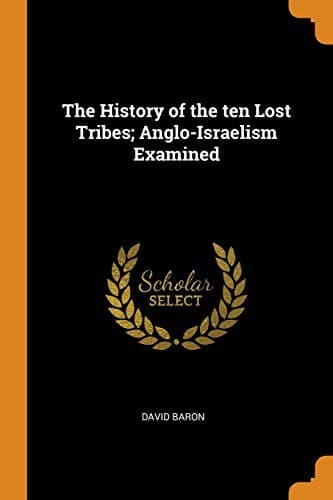
The History of the Ten "Lost" Tribes: Anglo-Israelism ExaminedBaron, David
History
The History of the Ten "Lost" Tribes: Anglo-Israelism Examined
Baron, David
Anglo-Israelism; Jews -- History; Lost tribes of Israel
"The natural seed of Abraham," we are told, "is divided in the
Bible, the word Israel standing generally for the Ten Tribes, and
Judah for Two Tribes. These divisions have separate paths appointed
them to walk in through the centuries. 'All the House of Israel
wholly,' 'the whole House of Israel,' 'all the House of Israel,'
have a special work. The Ten Tribes are especially called in the
Scriptures the seed of Abraham. Sometimes 'My chosen'; again, 'Mine
inheritance,' and 'My servant.' God, in referring to them in their
scattered state, and of His gathering them together, says (Isaiah
xli. 8): 'But thou, Israel, art My servant, Jacob whom I have
chosen; the seed of Abraham My friend--thou whom I have taken from
the ends of the earth, and called thee from the chief men thereof,
and said unto thee, Thou art My servant; I have chosen thee, and
not cast thee away.'"[13]
I shall show later on that it is not true to say that the word Israel
stands "generally" for the Ten Tribes, and Judah for the Two Tribes.
"Generally," the name Israel stands for all the descendants of Jacob,
whose name was changed by God Himself to "Israel," though in the
historical books, especially in 1 and 2 Kings, and 2 Chronicles, and in
a few passages in the Prophets, it is used to describe the northern
kingdom of the Ten Tribes in contradistinction to the southern kingdom
of Judah. But its use in the more limited and temporary sense as applied
to the Ten Tribes can always be clearly discerned from the context. But
in order to support the assertion that "these two divisions have
separate paths appointed them to walk through the centuries," it is
affirmed that the designations "All the House of Israel wholly," "the
whole House of Israel," "My chosen," "Mine inheritance," and "My
servant," are especially applied in the Scriptures to the "Ten Tribes"
in contradistinction to Judah. Now this is utterly baseless, as any
intelligent Bible-reader will find if he takes the trouble to look up
all the passages where these expressions are used.[14]
FOOTNOTES:
[Footnote 1: From the article "Anglo-Israelism" in the _Jewish
Encyclopedia_.]
[Footnote 2: Joseph Jacobs, B.A., in the _Jewish Encyclopedia_.]
[Footnote 3: See Note iv. in Part III.]
[Footnote 4: "Nebuchadnezzar's Dream" in "The British Empire of
Ephraim." A whole collection of similar perversions of Scripture may be
found in an excellent pamphlet by the late Pastor Frank H. White, called
"Anglo-Israelism Examined"--unfortunately now out of print.]
[Footnote 5: A beautiful specimen, this, of Anglo-Israel logic.]
[Footnote 6: "The Lost Ten Tribes," by Rev. Joseph Wild, D.D. A book
containing twenty discourses which abounds in statements and
"interpretations" as wild and unscriptural as this sample quoted from
Discourse XVIII.]
[Footnote 7: From an article in _The Banner of Israel_.]
Public-domain text, read in full here on John Shaqi.
Reviews
Reviews
No reviews yet
Be the first to share your thoughts on this work.
Join the Discussion
Join the discussion
Sign in to leave a comment or review.
Sign InorCreate an account