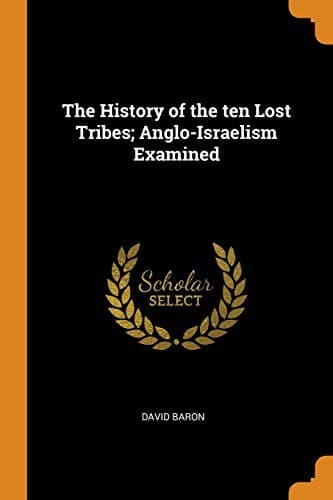
The History of the Ten "Lost" Tribes: Anglo-Israelism ExaminedBaron, David
History
The History of the Ten "Lost" Tribes: Anglo-Israelism Examined
Baron, David
Anglo-Israelism; Jews -- History; Lost tribes of Israel
As a matter of fact, these prophecies, and particularly Ezek. xxxvii.
15-28, set forth not one single act or event, but a _process_ which,
commencing with the prophet's own time, extends into the distant future,
and ends in the final goal of the blessed condition of Israel under
Messiah's reign in the millennial period. Thus, while the full visible
_manifestation_ of that unity, symbolised by the two sticks becoming
_one_ in the prophet's hand, will only be realised after the final
regathering of the whole nation in their own land, and when the true
"David," namely, Messiah, "David's greater Son," shall be both King and
Prince over them for ever--the merging and uniting process commenced, as
a matter of fact, before the Babylonian captivity, was accelerated in
the exile, when in their like sorrows and troubles the hearts of the
people were doubtless drawn to one another in mutual sympathy and love.
The point, however, to be noticed in this and other prophecies is the
clear announcement which they contained that the purpose of God in the
schism--as a punishment on the House of David--_was now at an end_, and
that henceforth there was but one common hope and one destiny for the
whole Israel of the Twelve Tribes--whether they previously belonged to
the northern kingdom of the _Ten_ Tribes, or to the southern kingdom of
the _Two_ Tribes--and that this common hope and destiny was centred in
Him Who is the Lion of the Tribe of Judah, and the rightful Heir and
descendant of David.
In like manner Jeremiah, in his great prophecy of the restoration and
future blessing (chaps. xxx. and xxxi.), links the destinies of "Judah"
and "Israel," or Israel and Judah together; and speaks of one common
experience from that time on for the whole people. "For lo, the days
come, saith the Lord, that I will turn again the captivity of My people
Israel and Judah, saith the Lord: and I will cause them to return to the
land that I gave to their fathers, and they shall possess it. And these
are the words that the Lord spake concerning Israel and Judah" (Jer.
xxx. 3, 4, R.V.).
Daniel also, towards the end of the seventy years' captivity, includes
not only the men of Judah and inhabitants of Jerusalem in his
intercessory prayer, but "_all Israel_ that are near, or far off, from
all the countries whither Thou hast driven them," who, he confesses,
were alike involved in sin and judgment, and equally cast on the mercy
of God on the ground of promises made to the fathers.
Public-domain text, read in full here on John Shaqi.
Reviews
Reviews
No reviews yet
Be the first to share your thoughts on this work.
Join the Discussion
Join the discussion
Sign in to leave a comment or review.
Sign InorCreate an account