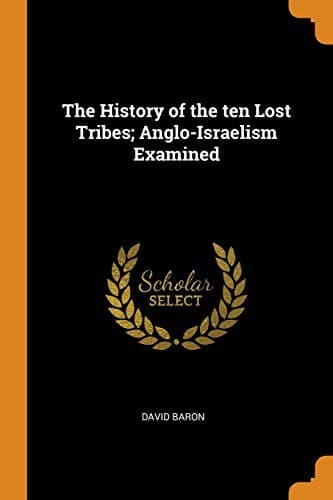
The History of the Ten "Lost" Tribes: Anglo-Israelism ExaminedBaron, David
History
The History of the Ten "Lost" Tribes: Anglo-Israelism Examined
Baron, David
Anglo-Israelism; Jews -- History; Lost tribes of Israel
The prophet Amos, though himself a Judean, his native village, Tekoa,
being about twelve miles south of Jerusalem, was commissioned by God to
prophesy more particularly to the northern or Ten-Tribed kingdom; and
for that purpose he went and took up his abode in Bethel, which was the
centre of the idolatrous worship set up by Jeroboam in opposition to the
worship and service of the divinely-appointed sanctuary in Jerusalem.
There his duty was to announce the coming judgment of God on the Israel
of the Ten Tribes, on account of their apostasy. The last paragraph of
his book (chap. ix. 8-15), uttered not more than about seventy years
before the final overthrow of Samaria in B.C. 721, is one of the most
remarkable and comprehensive prophecies in the Old Testament, and this
is the inspired forecast of the history of the Ten-Tribed kingdom which
is given in it: "_Behold, the eyes of the Lord God are upon the sinful
kingdom, and I will destroy it from off the face of the earth; saving
that I will not utterly destroy the house of Jacob, saith the Lord. For
lo, I will command and I will sift (or 'toss') the house of Israel among
all the nations, like as corn is sifted (or 'tossed' about) in a sieve,
yet shall not the least grain fall upon the earth. All the sinners of
thy people shall die by the sword, which say: The evil shall not
overtake or prevent us._"
Here, then, we have the whole subject as to what was to become of the
Ten Tribes in a nutshell.
(a) First, _as a kingdom_, they were to be destroyed from off the face
of the earth, _never to be restored_; for its very existence as a
separate kingdom was only permitted of God for a definite period as a
punishment on the house of David: and when, after a period of about two
hundred and fifty years of unbroken apostasy, it was finally broken up
by the Assyrians, there was an end of it, without any promise of a
future independent political existence.
(b) But when it was destroyed as a kingdom, what became of them as a
people? This prophecy tells us: "Saving that I will not utterly destroy
the house of Jacob, saith the Lord"--that is, they are to return to the
house of Jacob. They are to form part of the one family made up of all
the descendants of Jacob without distinction of tribes. But as one house
of Jacob, or "of Israel" (as the next verse interchangeably calls them),
something terrible and unique is to befall them; and what is it? To be
"lost" some two thousand six hundred years, and then to be identified
with the Anglo-Saxon race? Oh no! this is what was to happen: "For lo, I
will command and I will sift (or 'toss') the house of Israel among all
nations, even as corn is tossed about in a sieve"--or, in the words of
Hosea, another prophet, who spoke primarily to the Ten Tribes, "My God
will cast them away" (not for ever, as the whole book shows, but for a
time), "because they did not hearken unto Him; and _they shall be
wanderers among the nations_."
Public-domain text, read in full here on John Shaqi.
Reviews
Reviews
No reviews yet
Be the first to share your thoughts on this work.
Join the Discussion
Join the discussion
Sign in to leave a comment or review.
Sign InorCreate an account