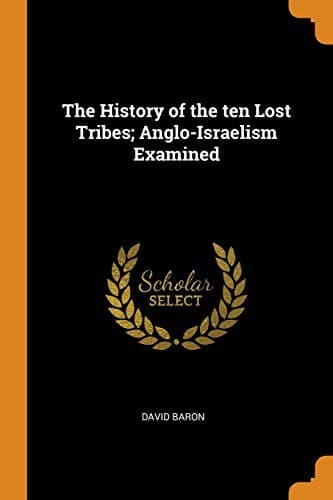
The History of the Ten "Lost" Tribes: Anglo-Israelism Examined — John Shaqi
The History of the Ten "Lost" Tribes: Anglo-Israelism ExaminedBaron, David
History
The History of the Ten "Lost" Tribes: Anglo-Israelism Examined
Baron, David
Anglo-Israelism; Jews -- History; Lost tribes of Israel
"Altogether, by the application of wild guess-work about historical
origins and philological analogies, and by a slavishly literal
interpretation (or misapplication) of selected phrases of prophecy,
a case is made out for the identification of the British race with
the Lost Ten Tribes of Israel sufficient to satisfy uncritical
persons desirous of finding their pride of race confirmed by Holy
Scripture. The whole theory rests upon an identification of the
word 'isles' in the English version of the Bible unjustified by
modern philology, which identifies the original word with 'coasts'
or 'distant lands,' without any implication of their being
surrounded by the sea. Modern ethnography does not confirm in any
way the identification of the Irish with a Semitic people; while
the English can be traced back to the Scandinavians, of whom there
is no trace in Mesopotamia at any period of history. The whole
movement is chiefly interesting as a _reductio ad absurdum_ of too
literal an interpretation (or misapplication) of the
prophecies."[2]
To this let me add the verdict of a prominent Christian scholar.
Commenting on Edward Hine's "Identifications of the British Nation with
Lost Israel," Professor Rawlinson wrote that: "The pamphlet is not
calculated to produce the slightest effect on the opinion of those
competent to form one. Such effect as it may have can only be on the
ignorant and unlearned--on those who are unaware of the absolute and
entire diversity in language, physical type, religious opinions, and
manners and customs, between the Israelites and the various races from
whom the English nation can be shown historically to be descended."
The fact of the matter is that the so-called historical proofs, by which
the theory is supported, are derived from heathen myths and fables,[3]
and the philology which traces "British" to "Berith-ish," and "Saxon" to
"Isaac's-son," etc., deserves no other characterisation than
_child-ish_.
Public-domain text, read in full here on John Shaqi.
Reviews
Reviews
No reviews yet
Be the first to share your thoughts on this work.
Join the Discussion
Join the discussion
Sign in to leave a comment or review.
Sign InorCreate an account