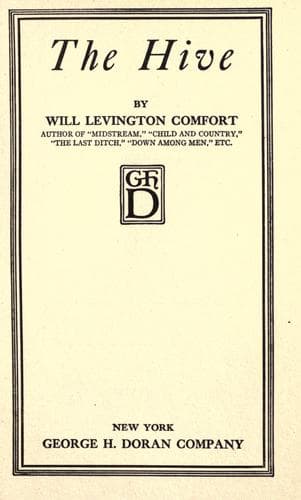
American essays -- 20th century; Child development; Children; Education
I followed him during all the vacations. He loved the North
Country--snow on the mountains, cold night rains, the filled fields and
shrunken rivers of summer, the sound and natural things. He said he
would find his tropical island when his work was done, but that work
meant Russia to him. He was genius. Every one loved him. One vacation
time we undertook to walk together over the Torqueval Peaks. He
borrowed a guitar at a peasant house there in the mountains, and played
for an hour as I have never heard any one play. I had been with him for
almost three years and had not known he touched the instrument.
In one of those days of our walking-tour in the mountains an instance
occurred of Varsieff's immeasurable tenderness of heart. One golden
morning as we walked through a little village, past a vined wicker
fence--a huge yellow cat sprang forth from the leaves and caught a bird
on the wing. A kind of sob came from my friend at the swift little
tragedy enacted in the wonderful morning light. I turned--Varsieff's
face was back to its childhood--a depiction of childish horror--all
finished manhood erased.
Many times in our talk his sentences formed a poem, which I would rush
away to put down. He learned to do this alone afterward. Once I went
to his room in Moscow after I had been away several months, and found
scattered among clothing, papers, books and tea-things, a set of recent
lyrical gems of his. These I gathered together in the little book, now
marching around the world.
I smile to remember when I came to learn that Varsieff had other
friends as devoted as I. It hurt at first; I could not understand. His
big magic then was that he wanted nothing. He used to say that a man is
at his worst when he wants anything for himself. The fact is Varsieff
in wanting the _letter_ of nothing, really wanted the spirit of all;
in wanting nothing for himself in those days, he wanted everything for
the world, a new heaven and a new earth, first and especially a new
Russia. Then the day came when he wanted a woman. This was altogether
unexpected. I thought that Varsieff absolutely had given himself to
the revolution--that humanity was his bride.
I was with him when he first saw Paula Mantone--that is but part of her
name. It was in Moscow. His voice, as he spoke to me, watching her, had
a different and deeper inflection than I ever heard before. She was
just a girl--poorly dressed, who had paused to speak laughingly to an
old flower-woman.
"Wait, Lange," he said to me, and crossed to her.
It was in the Spring of the year. The morning was very bright. She
turned from the tray of flowers and looked up at him. His hands went
out to her shoulders. He was searching her face with a queer and tense
smile--as one who finds a woman after a few months' separation in one
whom he has left a child. Of course, my thought was that he had known
her before. She, too, would have slept at his door....
Public-domain text, read in full here on John Shaqi.
Reviews
Reviews
No reviews yet
Be the first to share your thoughts on this work.
Elsewhere in the archive
Join the Discussion
Join the discussion
Sign in to leave a comment or review.
Sign InorCreate an account