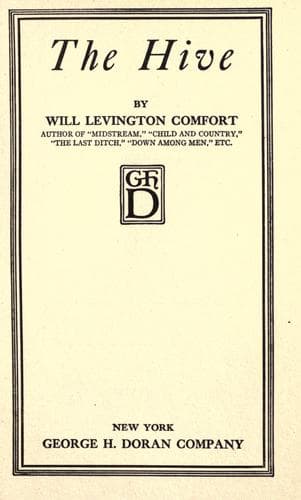
American essays -- 20th century; Child development; Children; Education
I heard their voices. He asked her name, where she lived, and how he
could reach her again. It all seemed trifling to me. Varsieff had never
been like this before. The rest of the day he was silent. We walked and
dined together, but his thoughts were not for me. For once, they were
not for Russia. There was a smile in his eyes, and often he turned back
the way we had come. Once he said:
"I had to leave her. It was quite all I could stand. I do not think the
world is a place for two such people to be happy in. Possibly, we may
be allowed to meet from time to time----"
I was inclined to call this nonsense. A little later he added strangely:
"Yes, it would be dangerous to let go and become merely human in a case
like this."
The next three years Varsieff and I were much apart. I do not profess
quite to understand the obstacles between him and Paula Mantone.
They had loved each other instantly and torrentially. They were much
together, yet there was some super-human torture about it. Even if I
have a glimpse of the mystery, I'm afraid few will understand. There is
something back of each one of us greater than our actions. We are all
greater than we seem. It was as if Varsieff and Paula Mantone were only
intended to meet here--to meet and quicken each other for a greater
giving to the world. I wonder if it is quite true, what he said toward
the last: That really splendid lovers may consecrate themselves to each
other, but they must also learn to give each other to the world.... In
the beginning they tried to lose themselves in each other, and they
encountered untellable pain.
At length came the night when Varsieff returned to my lodgings, saying
that it was only a question of time when they should find peace. He
said he knew they would find peace, for he had already touched it
momentarily. I wondered if she were dead, and he caught my thought.
"No, Lange," he said. "I am still to see her from time to time."
Before that first meeting with Paula Mantone in the street, Varsieff
had loved Russia and the world, a friend and comrade to me and to many
others. All his love had suddenly been called in and directed upon the
woman. After the three years, he gave himself to all of us again--but
a quickened illuminated man. He had been brilliant to me before that,
but the brilliance of phosphorous compared to sunlight now. Varsieff
was making some strange spiritual initiation out of his love story. His
presence glorified me on the night of his coming--the summer before the
war.
"There are four layers to Russia," I remember him saying. "The royalty
on top, then the dreamers, then the middlemen, then the peasants. Kings
and middlemen go together; dreamers and peasants go together.... Yes,
time will come when the dreamers and the peasants truly shall belong to
each other. They have been lovers a long time."
I asked him about the other pair.
"The kings and the middlemen will cancel each other," he answered.
Public-domain text, read in full here on John Shaqi.
Reviews
Reviews
No reviews yet
Be the first to share your thoughts on this work.
Elsewhere in the archive
Join the Discussion
Join the discussion
Sign in to leave a comment or review.
Sign InorCreate an account