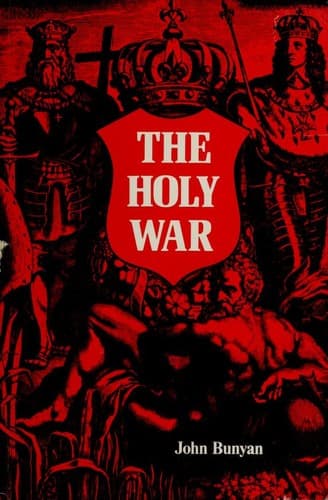
The Holy War, Made by King Shaddai Upon Diabolus, for the Regaining of the Metropolis of the World; Or, The Losing and Taking Again of the Town of MansoulBunyan, John
ReligionChristian
The Holy War, Made by King Shaddai Upon Diabolus, for the Regaining of the Metropolis of the World; Or, The Losing and Taking Again of the Town of Mansoul
Bunyan, John
Christian fiction; Soul; Spiritual warfare -- Fiction
Diabolus having thus armed and forearmed his servants and vassals in
Mansoul against their good and lawful King Shaddai, in the next place, he
doubleth his guards at the gates of the town, and he takes himself to the
castle, which was his stronghold. His vassals also, to show their wills,
and supposed (but ignoble) gallantry, exercise themselves in their arms
every day, and teach one another feats of war; they also defied their
enemies, and sang up the praises of their tyrant; they threatened also
what men they would be if ever things should rise so high as a war
between Shaddai and their king.
Now all this time the good King, the King Shaddai, was preparing to send
an army to recover the town of Mansoul again from under the tyranny of
their pretended king Diabolus; but he thought good, at first, not to send
them by the hand and conduct of brave Emmanuel his Son, but under the
hand of some of his servants, to see first by them the temper of Mansoul,
and whether by them they would be won to the obedience of their King.
The army consisted of above forty thousand, all true men, for they came
from the King’s own court, and were those of his own choosing.
They came up to Mansoul under the conduct of four stout generals, each
man being a captain of ten thousand men, and these are their names and
their ensigns. The name of the first was Boanerges, the name of the
second was Captain Conviction, the name of the third was Captain
Judgment, and the name of the fourth was Captain Execution. These were
the captains that Shaddai sent to regain Mansoul.
These four captains, as was said, the King thought fit, in the first
place, to send to Mansoul, to make an attempt upon it; for indeed
generally in all his wars he did use to send these four captains in the
van, for they were very stout and rough-hewn men, men that were fit to
break the ice, and to make their way by dint of sword, and their men were
like themselves.
To each of these captains the King gave a banner, that it might be
displayed, because of the goodness of his cause, and because of the right
that he had to Mansoul.
First, to Captain Boanerges, for he was the chief, to him, I say, were
given ten thousand men. His ensign was Mr. Thunder; he bare the black
colours, and his scutcheon was the three burning thunderbolts.
The second captain was Captain Conviction; to him also were given ten
thousand men. His ensign’s name was Mr. Sorrow; he did bear the pale
colours, and his scutcheon was the book of the law wide open, from whence
issued a flame of fire.
The third captain was Captain Judgment; to him were given ten thousand
men. His ensign’s name was Mr. Terror; he bare the red colours, and his
scutcheon was a burning fiery furnace.
The fourth captain was Captain Execution; to him were given ten thousand
men. His ensign was one Mr. Justice; he also bare the red colours, and
his scutcheon was a fruitless tree, with an axe lying at the root
thereof.
Public-domain text, read in full here on John Shaqi.
Reviews
Reviews
No reviews yet
Be the first to share your thoughts on this work.
Join the Discussion
Join the discussion
Sign in to leave a comment or review.
Sign InorCreate an account