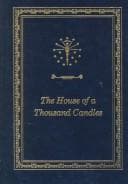
The House of a Thousand CandlesNicholson, Meredith
General
The House of a Thousand Candles
Nicholson, Meredith
Indiana -- Fiction; Inheritance and succession -- Fiction; Mystery and detective stories
“I suppose,” he continued, “you accept as gospel
truth what that fellow tells you about the estate. I
should be a little wary if I were you. Now, I’ve been
kicking around here for a couple of weeks, dodging the
detectives, and incidentally reading the newspapers.
Perhaps you don’t understand that this estate of John
Marshall Glenarm has been talked about a good bit.”
“I didn’t know it,” I admitted lamely. Larry had
always been able to instruct me about most matters; it
was wholly possible that he could speak wisely about my
inheritance.
“You couldn’t know, when you were coming from
the Mediterranean on a steamer. But the house out
there and the mysterious disappearance of the property
have been duly discussed. You’re evidently an object
of some public interest,”—and he drew from his pocket
a newspaper cutting. “Here’s a sample item.” He read:
“John Glenarm, the grandson of John Marshall Glenarm,
the eccentric millionaire who died suddenly in Vermont
last summer, arrived on the Maxinkuckee from Naples
yesterday. Under the terms of his grandfather’s
will, Glenarm is required to reside for a year at a curious
house established by John Marshall Glenarm near Lake
Annandale, Indiana.
This provision was made, according to friends of the
family, to test young Glenarm’s staying qualities, as he
has, since his graduation from the Massachusetts Institute
of Technology five years ago, distributed a considerable
fortune left him by his father in contemplating the
wonders of the old world. It is reported—”
“That will do! Signs and wonders I have certainly
beheld, and if I spent the money I submit that I got
my money back.”
I paid my bill and took a hansom for the ferry,—
Larry with me, chaffing away drolly with his old zest.
He crossed with me, and as the boat drew out into the
river a silence fell upon us,—the silence that is possible
only between old friends. As I looked back at the lights
of the city, something beyond the sorrow at parting
from a comrade touched me. A sense of foreboding, of
coming danger, crept into my heart. But I was going
upon the tamest possible excursion; for the first time
in my life I was submitting to the direction of another,
—albeit one who lay in the grave. How like my grandfather
it was, to die leaving this compulsion upon me!
My mood changed suddenly, and as the boat bumped at
the pier I laughed.
“Bah! these men!” ejaculated Larry.
“What men?” I demanded, giving my bags to a
porter.
“These men who are in love,” he said. “I know the
signs,—mooning, silence, sudden inexplicable laughter!
I hope I’ll not be in jail when you’re married.”
“You’ll be in a long time if they hold you for that.
Here’s my train.”
We talked of old times, and of future meetings, during
the few minutes that remained.
“You can write me at my place of rustication,” I
said, scribbling “Annandale, Wabana County, Indiana,”
on a card. “Now if you need me at any time I’ll come
to you wherever you are. You understand that, old man.
Good-by.”
Public-domain text, read in full here on John Shaqi.
Reviews
Reviews
No reviews yet
Be the first to share your thoughts on this work.
Join the Discussion
Join the discussion
Sign in to leave a comment or review.
Sign InorCreate an account