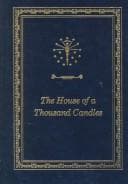
The House of a Thousand CandlesNicholson, Meredith
General
The House of a Thousand Candles
Nicholson, Meredith
Indiana -- Fiction; Inheritance and succession -- Fiction; Mystery and detective stories
These were my yesterdays; but to-day I sat in Arthur
Pickering’s office in the towering Alexis Building, conscious
of the muffled roar of Broadway, discussing the
terms of my Grandfather Glenarm’s will with a man
whom I disliked as heartily as it is safe for one man to
dislike another. Pickering had asked me a question,
and I was suddenly aware that his eyes were fixed upon
me and that he awaited my answer.
“What do I think of it?” I repeated. “I don’t know
that it makes any difference what I think, but I’ll tell
you, if you want to know, that I call it infamous, outrageous,
that a man should leave a ridiculous will of
that sort behind him. All the old money-bags who pile
up fortunes magnify the importance of their money.
They imagine that every kindness, every ordinary courtesy
shown them, is merely a bid for a slice of the cake.
I’m disappointed in my grandfather. He was a splendid
old man, though God knows he had his queer ways.
I’ll bet a thousand dollars, if I have so much money in
the world, that this scheme is yours, Pickering, and not
his. It smacks of your ancient vindictiveness, and John
Marshall Glenarm had none of that in his blood. That
stipulation about my residence out there is fantastic.
I don’t have to be a lawyer to know that; and no doubt
I could break the will; I’ve a good notion to try it,
anyhow.”
“To be sure. You can tie up the estate for half
a dozen years if you like,” he replied coolly. He did
not look upon me as likely to become a formidable
litigant. My staying qualities had been proved weak
long ago, as Pickering knew well enough.
“No doubt you would like that,” I answered. “But
I’m not going to give you the pleasure. I abide by the
terms of the will. My grandfather was a fine old gentleman.
I shan’t drag his name through the courts,
not even to please you, Arthur Pickering,” I declared
hotly.
“The sentiment is worthy of a good man, Glenarm,”
he rejoined.
“But this woman who is to succeed to my rights,—I
don’t seem to remember her.”
“It is not surprising that you never heard of her.”
“Then she’s not a connection of the family,—no long-lost
cousin whom I ought to remember?”
“No; she was a late acquaintance of your grandfather’s.
He met her through an old friend of his,—
Miss Evans, known as Sister Theresa. Miss Devereux
is Sister Theresa’s niece.”
I whistled. I had a dim recollection that during my
grandfather’s long widowerhood there were occasional
reports that he was about to marry. The name of Miss
Evans had been mentioned in this connection. I had
heard it spoken of in my family, and not, I remembered,
with much kindness. Later, I heard of her joining a
Sisterhood, and opening a school somewhere in the
West.
“And Miss Devereux,—is she an elderly nun, too?”
“I don’t know how elderly she is, but she isn’t a nun
at present. Still, she’s almost alone in the world, and
she and Sister Theresa are very intimate.”
Public-domain text, read in full here on John Shaqi.
Reviews
Reviews
No reviews yet
Be the first to share your thoughts on this work.
Join the Discussion
Join the discussion
Sign in to leave a comment or review.
Sign InorCreate an account