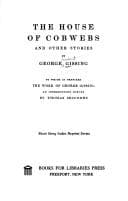
The House of Cobwebs and Other Stories — John Shaqi
The House of Cobwebs and Other StoriesGissing, George
General
The House of Cobwebs and Other Stories
Gissing, George
Great Britain -- Social life and customs -- 19th century -- Fiction; Short stories
The influence of Dickens clearly predominated when Gissing wrote his next
novel and first really notable and artistic book, _Thyrza_.[8] The figure
which irradiates this story is evidently designed in the school of Dickens:
it might almost be a pastel after some more highly finished work by Daudet.
But Daudet is a more relentless observer than Gissing, and to find a
parallel to this particular effect I think we must go back a little farther
to the heroic age of the _grisette_ and the tearful _Manchon de Francine_
of Henri Murger. _Thyrza_, at any rate, is a most exquisite picture in
half-tones of grey and purple of a little Madonna of the slums; she is in
reality the _belle fleur d'un fumier_ of which he speaks in the epigraph of
the _Nether World_. The _fumier_ in question is Lambeth Walk, of which we
have a Saturday night scene, worthy of the author of _L'Assommoir_ and _Le
Ventre de Paris_ in his most perceptive mood. In this inferno, amongst the
pungent odours, musty smells and 'acrid exhalations from the shops where
fried fish and potatoes hissed in boiling grease,' blossomed a pure white
lily, as radiant amid mean surroundings as Gemma in the poor Frankfort
confectioner's shop of Turgenev's _Eaux Printanières._ The pale and rather
languid charm of her face and figure are sufficiently portrayed without any
set description. What could be more delicate than the intimation of the
foregone 'good-night' between the sisters, or the scene of Lyddy plaiting
Thyrza's hair? The delineation of the upper middle class culture by which
this exquisite flower of maidenhood is first caressed and transplanted,
then slighted and left to wither, is not so satisfactory. Of the upper
middle class, indeed, at that time, Gissing had very few means of
observation. But this defect, common to all his early novels, is more than
compensated by the intensely pathetic figure of Gilbert Grail, the
tender-souled, book-worshipping factory hand raised for a moment to the
prospect of intellectual life and then hurled down by the caprice of
circumstance to the unrelenting round of manual toil at the soap and candle
factory. Dickens would have given a touch of the grotesque to Grail's
gentle but ungainly character; but at the end he would infallibly have
rewarded him as Tom Pinch and Dominie Sampson were rewarded. Not so George
Gissing. His sympathy is fully as real as that of Dickens. But his fidelity
to fact is greater. Of the Christmas charity prescribed by Dickens, and of
the untainted pathos to which he too rarely attained, there is an abundance
in _Thyrza_. But what amazes the chronological student of Gissing's work is
the magnificent quality of some of the writing, a quality of which he had
as yet given no very definite promise. Take the following passage, for
example:--
Public-domain text, read in full here on John Shaqi.
Reviews
Reviews
No reviews yet
Be the first to share your thoughts on this work.
Join the Discussion
Join the discussion
Sign in to leave a comment or review.
Sign InorCreate an account