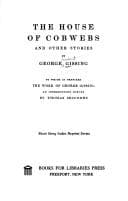
The House of Cobwebs and Other StoriesGissing, George
General
The House of Cobwebs and Other Stories
Gissing, George
Great Britain -- Social life and customs -- 19th century -- Fiction; Short stories
'Well, the first thing to do was to answer Mrs. Weare's letter. He lit his
lamp and sat down at the crazy little deal table; but his pen dipped
several times into the ink before he found himself able to write.
'Dear Mrs. Weare,'--
Then, so long a pause that he seemed to be falling asleep. With a jerk, he
bent again to his task.
'With sincere gratitude I acknowledge the receipt of your most kind
and generous donation. The money...'
(Again his hand lay idle for several minutes.)
'shall be used as you wish, and I will render to you a detailed
account of the benefits conferred by it.'
Never had he found composition so difficult. He felt that he was expressing
himself wretchedly; a clog was on his brain. It cost him an exertion of
physical strength to conclude the letter. When it was done, he went out,
purchased a stamp at a tobacconist's shop, and dropped the envelope into
the post.
Little slumber had Mr. Tymperley that night. On lying down, he began to
wonder where he should find the poor people worthy of sharing in this
benefaction. Of course he had no acquaintance with the class of persons of
whom Mrs. Weare was thinking. In a sense, all the families round about were
poor, but--he asked himself--had poverty the same meaning for them as for
him? Was there a man or woman in this grimy street who, compared with
himself, had any right to be called poor at all? An educated man forced to
live among the lower classes arrives at many interesting conclusions with
regard to them; one conclusion long since fixed in Mr. Tymperley's mind was
that the 'suffering' of those classes is very much exaggerated by outsiders
using a criterion quite inapplicable. He saw around him a world of coarse
jollity, of contented labour, and of brutal apathy. It seemed to him more
than probable that the only person in this street conscious of poverty, and
suffering under it, was himself.
From nightmarish dozing, he started with a vivid thought, a recollection
which seemed to pierce his brain. To whom did he owe his fall from comfort
and self-respect, and all his long miseries? To Mrs. Weare's father. And,
from this point of view, might the cheque for five pounds be considered as
mere restitution? Might it not strictly be applicable to his own
necessities?
Another little gap of semi-consciousness led to another strange reflection.
What if Mrs. Weare (a sensible woman) suspected, or even had discovered,
the truth about him. What if she secretly _meant_ the money for his own
use?
Earliest daylight made this suggestion look very insubstantial; on the
other hand, it strengthened his memory of Mr. Charman's virtual
indebtedness to him. He jumped out of bed to reach the cheque, and for an
hour lay with it in his hand. Then he rose and dressed mechanically.
Public-domain text, read in full here on John Shaqi.
Reviews
Reviews
No reviews yet
Be the first to share your thoughts on this work.
Elsewhere in the archive
Join the Discussion
Join the discussion
Sign in to leave a comment or review.
Sign InorCreate an account