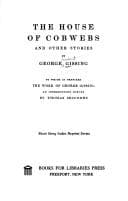
The House of Cobwebs and Other StoriesGissing, George
General
The House of Cobwebs and Other Stories
Gissing, George
Great Britain -- Social life and customs -- 19th century -- Fiction; Short stories
After the day's work he rambled in a street of large shops. A bootmaker's
arrested him; he stood before the window for a long time, turning over and
over in his pocket a sovereign--no small fraction of the ready coin which
had to support him until dividend day. Then he crossed the threshold.
Never did man use less discretion in the purchase of a pair of boots. His
business was transacted in a dream; he spoke without hearing what he said;
he stared at objects without perceiving them. The result was that not till
he had got home, with his easy old footgear under his arm, did he become
aware that the new boots pinched him most horribly. They creaked too:
heavens! how they creaked! But doubtless all new boots had these faults; he
had forgotten; it was so long since he had bought a pair. The fact was, he
felt dreadfully tired, utterly worn out. After munching a mouthful of
supper he crept into bed.
All night long he warred with his new boots. Footsore, he limped about the
streets of a spectral city, where at every corner some one seemed to lie in
ambush for him, and each time the lurking enemy proved to be no other than
Mrs. Weare, who gazed at him with scornful eyes and let him totter by. The
creaking of the boots was an articulate voice, which ever and anon screamed
at him a terrible name. He shrank and shivered and groaned; but on he went,
for in his hand he held a crossed cheque, which he was bidden to get
changed, and no one would change it. What a night!
When he woke his brain was heavy as lead; but his meditations were very
lucid. Pray, what did he mean by that insane outlay of money, which he
could not possibly afford, on a new (and detestable) pair of boots? The old
would have lasted, at all events, till winter began. What was in his mind
when he entered the shop? Did he intend...? Merciful powers!
Mr. Tymperley was not much of a psychologist. But all at once he saw with
awful perspicacity the moral crisis through which he had been living. And
it taught him one more truth on the subject of poverty.
Immediately after his breakfast he went downstairs and tapped at the door
of Mr. Suggs' sitting-room.
'What is it?' asked the bookbinder, who was eating his fourth large rasher,
and spoke with his mouth full.
'Sir, I beg leave of absence for an hour or two this morning. Business of
some moment demands my attention.'
Mr. Suggs answered, with the grace natural to his order, 'I s'pose you can
do as you like. I don't pay you nothing.'
The other bowed and withdrew.
Two days later he again penned a letter to Mrs. Weare. It ran thus:--
'The money which you so kindly sent, and which I have already
acknowledged, has now been distributed. To ensure a proper use of it,
I handed the cheque, with clear instructions, to a clergyman in this
neighbourhood, who has been so good as to jot down, on the sheet
enclosed, a memorandum of his beneficiaries, which I trust will be
satisfactory and gratifying to you.
Public-domain text, read in full here on John Shaqi.
Reviews
Reviews
No reviews yet
Be the first to share your thoughts on this work.
Elsewhere in the archive
Join the Discussion
Join the discussion
Sign in to leave a comment or review.
Sign InorCreate an account