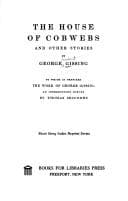
The House of Cobwebs and Other Stories — John Shaqi
The House of Cobwebs and Other StoriesGissing, George
General
The House of Cobwebs and Other Stories
Gissing, George
Great Britain -- Social life and customs -- 19th century -- Fiction; Short stories
This superb piece of imaginative prose, of which Shorthouse himself might
have been proud,[9] is recalled by an answering note in _Ryecroft_, in
which he says, 'I owe many a page to the street-organs.'
And, where the pathos has to be distilled from dialogue, I doubt if the
author of _Jack_ himself could have written anything more restrainedly
touching or in a finer taste than this:--
[Footnote 9: I am thinking, in particular, of the old vielle-player's
conversation in chap. xxiii. of _John Inglesant_; of the exquisite passage
on old dance music--its inexpressible pathos--in chap. xxv.]
'Laughing with kindly mirth, the old man drew on his woollen gloves
and took up his hat and the violin-bag. Then he offered to say
good-bye.
"But you're forgetting your top-coat, grandad," said Lydia.
"I didn't come in it, my dear."
"What's that, then? I'm sure _we_ don't wear such things."
She pointed to a chair, on which Thyrza had just artfully spread the
gift. Mr. Boddy looked in a puzzled way; had he really come in his
coat and forgotten it? He drew nearer.
"That's no coat o' mine, Lyddy," he said.
Thyrza broke into a laugh.
"Why, whose is it, then?" she exclaimed. "Don't play tricks, grandad;
put it on at once!"
"Now come, come; you're keeping Mary waiting," said Lydia, catching up
the coat and holding it ready.
Then Mr. Boddy understood. He looked from Lydia to Thyrza with dimmed
eyes.
"I've a good mind never to speak to either of you again," he said in a
tremulous voice. "As if you hadn't need enough of your money! Lyddy,
Lyddy! And you're as had, Thyrza, a grownup woman like you; you ought
to teach your sister better. Why, there; it's no good; I don't know
what to say to you. Now what do you think of this, Mary?"
Lydia still held up the coat, and at length persuaded the old man to
don it. The effect upon his appearance was remarkable; conscious of
it, he held himself more upright and stumped to the little square of
looking-glass to try and regard himself. Here he furtively brushed a
hand over his eyes.
"I'm ready, Mary, my dear; I'm ready! It's no good saying anything to
girls like these. Good-bye, Lyddy; good-bye, Thyrza. May you have a
happy Christmas, children! This isn't the first as you've made a happy
one for me."'--(p. 117.)
Public-domain text, read in full here on John Shaqi.
Reviews
Reviews
No reviews yet
Be the first to share your thoughts on this work.
Join the Discussion
Join the discussion
Sign in to leave a comment or review.
Sign InorCreate an account