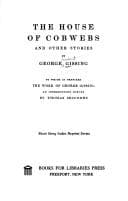
The House of Cobwebs and Other StoriesGissing, George
General
The House of Cobwebs and Other Stories
Gissing, George
Great Britain -- Social life and customs -- 19th century -- Fiction; Short stories
His name was Topham; he had a university degree and a damaged reputation.
Six months ago, when his choice seemed to be between staying in the streets
and turning sandwich-man, luck had made him acquainted with Mr. Rudolph
Starkey, who wrote himself M.A. of Dublin University and advertised a
system of tuition by correspondence. In return for mere board and lodging
Topham became Mr. Starkey's assistant; that is to say, he did by far the
greater part of Mr. Starkey's work. The tutorial business was but
moderately successful; still, it kept its proprietor in cigarettes, and
enabled him to pass some hours a day at a club, where he was convinced that
before long some better chance in life would offer itself to him. Having
always been a lazy dog, Starkey regarded himself as an example of industry
unrewarded; being as selfish a fellow as one could meet, he reproached
himself with the unworldliness of his nature, which had so hindered him in
a basely material age. One of his ventures was a half-moral, half-practical
little volume entitled _Success in Life_. Had it been either more moral or
more practical, this book would probably have yielded him a modest income,
for such works are dear to the British public; but Rudolph Starkey, M.A.,
was one of those men who do everything by halves and snarl over the
ineffectual results.
Topham's fault was that of a man who had followed his instincts but too
thoroughly. They brought him to an end of everything, and, as Starkey said,
he had been glad enough to take the employment which was offered without
any inconvenient inquiries. The work which he undertook he did competently
and honestly for some time without a grumble. Beginning with a certain
gratitude to his employer, though without any liking, he soon grew to
detest the man, and had much ado to keep up a show of decent civility in
their intercourse. Of better birth and breeding than Starkey, he burned
with resentment at the scant ceremony with which he was treated, and
loathed the meanness which could exact so much toil for such poor
remuneration. When offering his terms Starkey had talked in that bland way
characteristic of him with strangers.
'I'm really ashamed to propose nothing better to a man of your standing.
But--well, I'm making a start, you see, and the fact of the matter is that,
just at present, I could very well manage to do all the work myself. Still,
if you think it worth your while, there's no doubt we shall get on
capitally together, and, of course, I need not say, as soon as our progress
justifies it, we must come to new arrangements. A matter of six or seven
hours a day will be all I shall ask of you at present. For my own part, I
work chiefly at night.'
CHAPTER II
By the end of the first month Topham was working, not six or seven, but ten
or twelve hours a day, and his spells of labour only lengthened as time
went on. Seeing himself victimised, he one day alluded to the promise of
better terms, but Starkey turned sour.
Public-domain text, read in full here on John Shaqi.
Reviews
Reviews
No reviews yet
Be the first to share your thoughts on this work.
Elsewhere in the archive
Join the Discussion
Join the discussion
Sign in to leave a comment or review.
Sign InorCreate an account