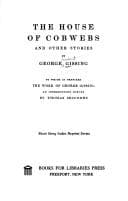
The House of Cobwebs and Other StoriesGissing, George
General
The House of Cobwebs and Other Stories
Gissing, George
Great Britain -- Social life and customs -- 19th century -- Fiction; Short stories
'You surprise me, Topham. Here are we, practically partners, doing our best
to make this thing a success, and all at once you spring upon me an
unreasonable demand. You know how expensive these rooms are--for we must
have a decent address. If you are dissatisfied, say so, and give me time to
look out for some one else.'
Topham was afraid of the street, and that his employer well knew. The
conversation ended in mutual sullenness, which thenceforward became the
note of their colloquies. Starkey felt himself a victim of ingratitude, and
consequently threw even more work upon his helpless assistant. That the
work was so conscientiously done did not at all astonish him. Now and then
he gave himself the satisfaction of finding fault: just to remind Topham
that his bread depended on another's goodwill. Congenial indolence grew
upon him, but he talked only the more of his ceaseless exertions. Sometimes
in the evening he would throw up his arms, yawn wearily, and declare that
so much toil with such paltry results was a heart-breaking thing.
Topham stared sullenly at the sixpence. This was but the latest of many
insults, yet never before had he so tasted the shame of his subjection.
Though he was earning a living, and a right to self-respect, more
strenuously than Starkey ever had, this fellow made him feel like a
mendicant. His nerves quivered, he struck the table fiercely, shouting
within himself, 'Brute! Cad!' Then he pocketed the coin and got on with his
duties.
It was toil of a peculiarly wearisome and enervating kind. Starkey's
advertisements, which were chiefly in the country newspapers, put him in
communication with persons of both sexes, and of any age from seventeen
onwards, the characteristic common to them all being inexperience and
intellectual helplessness. Most of these correspondents desired to pass
some examination; a few aimed--or professed to aim--merely at
self-improvement, or what they called 'culture.' Starkey, of course,
undertook tuition in any subject, to any end, stipulating only that his
fees should be paid in advance. Throughout the day his slave had been
correcting Latin and Greek exercises, papers in mathematical or physical
science, answers to historical questions: all elementary and many
grotesquely bad. On completing each set he wrote the expected comment;
sometimes briefly, sometimes at considerable length. He now turned to a
bundle of so-called essays, and on opening the first could not repress a
groan. No! This was beyond his strength. He would make up the parcels for
post, write the half-dozen letters that must be sent to-day, and go out.
Had he not sixpence in his pocket?
Just as he had taken this resolve some one knocked at the sitting-room
door, and with the inattention of a man who expects nothing, Topham bade
enter.
'A gen'man asking for Mr. Starkey, sir,' said the servant.
'All right. Send him in.'
Public-domain text, read in full here on John Shaqi.
Reviews
Reviews
No reviews yet
Be the first to share your thoughts on this work.
Elsewhere in the archive
Join the Discussion
Join the discussion
Sign in to leave a comment or review.
Sign InorCreate an account