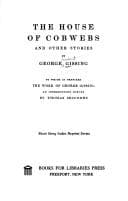
The House of Cobwebs and Other Stories — John Shaqi
The House of Cobwebs and Other StoriesGissing, George
General
The House of Cobwebs and Other Stories
Gissing, George
Great Britain -- Social life and customs -- 19th century -- Fiction; Short stories
The distinctive qualities of Gissing at the time of his setting forth were
a scholarly style, rather fastidious and academic in its restraint, and the
personal discontent, slightly morbid, of a self-conscious student who finds
himself in the position of a sensitive woman in a crowd. His attitude
through life was that of a man who, having set out on his career with the
understanding that a second-class ticket is to be provided, allows himself
to be unceremoniously hustled into the rough and tumble of a noisy third.
Circumstances made him revolt against an anonymous start in life for a
refined and educated man under such conditions. They also made him
prolific. He shrank from the restraints and humiliations to which the poor
and shabbily dressed private tutor is exposed--revealed to us with a
persuasive terseness in the pages of _The Unclassed, New Grub Street,
Ryecroft_, and the story of _Topham's Chance._ Writing fiction in a garret
for a sum sufficient to keep body and soul together for the six months
following payment was at any rate better than this. The result was a long
series of highly finished novels, written in a style and from a point of
view which will always render them dear to the studious and the
book-centred. Upon the larger external rings of the book-reading multitude
it is not probable that Gissing will ever succeed in impressing himself.
There is an absence of transcendental quality about his work, a failure in
humour, a remoteness from actual life, a deficiency in awe and mystery, a
shortcoming in emotional power, finally, a lack of the dramatic faculty,
not indeed indispensable to a novelist, but almost indispensable as an
ingredient in great novels of this particular genre.[1] In temperament and
vitality he is palpably inferior to the masters (Dickens, Thackeray, Hugo,
Balzac) whom he reverenced with such a cordial admiration and envy. A 'low
vitality' may account for what has been referred to as the 'nervous
exhaustion' of his style. It were useless to pretend that Gissing belongs
of right to the 'first series' of English Men of Letters. But if debarred
by his limitations from a resounding or popular success, he will remain
exceptionally dear to the heart of the recluse, who thinks that the scholar
does well to cherish a grievance against the vulgar world beyond the
cloister; and dearer still, perhaps, to a certain number of enthusiasts who
began reading George Gissing as a college night-course; who closed _Thyrza_
and _Demos_ as dawn was breaking through the elms in some Oxford
quadrangle, and who have pursued his work patiently ever since in a
somewhat toilsome and broken ascent, secure always of suave writing and
conscientious workmanship, of an individual prose cadence and a genuine
vein of Penseroso:--
'Thus, Night, oft see me in thy pale career...
Where brooding Darkness spreads his jealous wings,
And the night-raven sings.'
Public-domain text, read in full here on John Shaqi.
Reviews
Reviews
No reviews yet
Be the first to share your thoughts on this work.
Join the Discussion
Join the discussion
Sign in to leave a comment or review.
Sign InorCreate an account