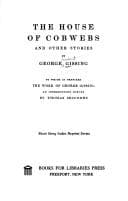
The House of Cobwebs and Other Stories — John Shaqi
The House of Cobwebs and Other StoriesGissing, George
General
The House of Cobwebs and Other Stories
Gissing, George
Great Britain -- Social life and customs -- 19th century -- Fiction; Short stories
In 1892 Gissing was already beginning to try and discard his down look, his
lugubrious self-pity, his lamentable cadence. He found some alleviation
from self-torment in _David Copperfield_, and he determined to borrow a
feather from 'the master's' pinion--in other words, to place an
autobiographical novel to his credit. The result was _Born in Exile_
(1892), one of the last of the three-volume novels,--by no means one of the
worst. A Hedonist of academic type, repelled by a vulgar intonation,
Gissing himself is manifestly the man in exile. Travel, fair women and
college life, the Savile club, and Great Malvern or the Cornish coast,
music in Paris or Vienna--this of course was the natural milieu for such a
man. Instead of which our poor scholar (with Homer and Shakespeare and
Pausanias piled upon his one small deal table) had to encounter the life of
the shabby recluse in London lodgings--synonymous for him, as passage after
passage in his books recounts, with incompetence and vulgarity in every
form, at best 'an ailing lachrymose slut incapable of effort,' more often
sheer foulness and dishonesty, 'by lying, slandering, quarrelling, by
drunkenness, by brutal vice, by all abominations that distinguish the
lodging-letter of the metropolis.' No book exhibits more naïvely the
extravagant value which Gissing put upon the mere externals of refinement.
The following scathing vignette of his unrefined younger brother by the
hero, Godfrey Peak, shows the ferocity with which this feeling could
manifest itself against a human being who lacked the elements of scholastic
learning (the brother in question had failed to give the date of the Norman
Conquest):--
'He saw much company and all of low intellectual order; he had
purchased a bicycle and regarded it as a source of distinction, or
means of displaying himself before shopkeepers' daughters; he believed
himself a moderate tenor and sang verses of sentimental imbecility; he
took in several weekly papers of unpromising title for the chief
purpose of deciphering cryptograms, in which pursuit he had singular
success. Add to these characteristics a penchant for cheap jewellery,
and Oliver Peak stands confessed.'
Public-domain text, read in full here on John Shaqi.
Reviews
Reviews
No reviews yet
Be the first to share your thoughts on this work.
Join the Discussion
Join the discussion
Sign in to leave a comment or review.
Sign InorCreate an account