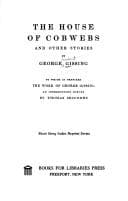
The House of Cobwebs and Other Stories — John Shaqi
The House of Cobwebs and Other StoriesGissing, George
General
The House of Cobwebs and Other Stories
Gissing, George
Great Britain -- Social life and customs -- 19th century -- Fiction; Short stories
Whatever the critics may determine as to the merit of the stories in the
present volume, there can be no question as to the interest they derive
from their connection with what had gone before. Thus _Topham's Chance_ is
manifestly the outcome of material pondered as early as 1884. _The Lodger
in Maze Pond_ develops in a most suggestive fashion certain problems
discussed in 1894. Miss Rodney is a re-incarnation of Rhoda Nunn and
Constance Bride. _Christopherson_ is a delicious expansion of a mood
indicated in _Ryecroft_ (Spring xii.), and _A Capitalist_ indicates the
growing interest in the business side of practical life, the dawn of which
is seen in _The Town Traveller_ and in the discussion of Dickens's
potentialities as a capitalist. The very artichokes in _The House of
Cobwebs_ (which, like the kindly hand that raised them, alas! fell a victim
to the first frost of the season) are suggestive of a charming passage
detailing the retired author's experience as a gardener. What Dr. Furnivall
might call the 'backward reach' of every one of these stories will render
their perusal delightful to those cultivated readers of Gissing, of whom
there are by no means a few, to whom every fragment of his suave and
delicate workmanship 'repressed yet full of power, vivid though sombre in
colouring,' has a technical interest and charm. Nor will they search in
vain for Gissing's incorrigible mannerisms, his haunting insistence upon
the note of 'Dort wo du nicht bist ist das Glück,' his tricks of the brush
in portraiture, his characteristic epithets, the _dusking_ twilight, the
_decently ignoble_ penury, the _not ignoble_ ambition, the _not wholly
base_ riot of the senses in early manhood. In my own opinion we have here
in _The Scrupulous Father_, and to a less degree, perhaps, in the first and
last of these stories, and in _A Poor Gentleman_ and _Christopherson_,
perfectly characteristic and quite admirable specimens of Gissing's own
genre, and later, unstudied, but always finished prose style.
* * * * *
But a few words remain to be said, and these, in part at any rate, in
recapitulation. In the old race, of which Dickens and Thackeray were
representative, a successful determination to rise upon the broad back of
popularity coincided with a growing conviction that the evil in the world
was steadily diminishing. Like healthy schoolboys who have worked their way
up to the sixth form, they imagined that the bullying of which they had had
to complain was become pretty much a thing of the past. In Gissing the
misery inherent in the sharp contrasts of modern life was a far more deeply
ingrained conviction. He cared little for the remedial aspect of the
question. His idea was to analyse this misery as an artist and to express
it to the world.
Public-domain text, read in full here on John Shaqi.
Reviews
Reviews
No reviews yet
Be the first to share your thoughts on this work.
Join the Discussion
Join the discussion
Sign in to leave a comment or review.
Sign InorCreate an account