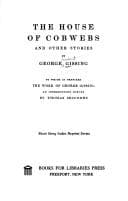
The House of Cobwebs and Other Stories — John Shaqi
The House of Cobwebs and Other StoriesGissing, George
General
The House of Cobwebs and Other Stories
Gissing, George
Great Britain -- Social life and customs -- 19th century -- Fiction; Short stories
To the Ercles vein of these Titans of fiction, Gissing was a complete
stranger. To the pale and fastidious recluse and anchorite, their tone of
genial remonstrance with the world and its ways was totally alien. He knew
nothing of the world to start with beyond the den of the student. His
second book, as he himself described it in the preface to a second edition,
was the work of a very young man who dealt in a romantic spirit with the
gloomier facts of life. Its title, _The Unclassed,_[3] excited a little
curiosity, but the author was careful to explain that he had not in view
the _déclassés_ but rather those persons who live in a limbo external to
society, and refuse the statistic badge. The central figure Osmond Waymark
is of course Gissing himself. Like his creator, raving at intervals under
the vile restraints of Philistine surroundings and with no money for
dissipation, Osmond gives up teaching to pursue the literary vocation. A
girl named Ida Starr idealises him, and is helped thereby to a purer life.
In the four years' interval between this somewhat hurried work and his
still earlier attempt the young author seems to have gone through a
bewildering change of employments. We hear of a clerkship in Liverpool, a
searing experience in America (described with but little deviation in _New
Grub Street_), a gas-fitting episode in Boston, private tutorships, and
cramming engagements in 'the poisonous air of working London.' Internal
evidence alone is quite sufficient to indicate that the man out of whose
brain such bitter experiences of the educated poor were wrung had learnt in
suffering what he taught--in his novels. His start in literature was made
under conditions that might have appalled the bravest, and for years his
steps were dogged by hunger and many-shaped hardships. He lived in cellars
and garrets. 'Many a time,' he writes, 'seated in just such a garret (as
that in the frontispiece to _Little Dorrit_) I saw the sunshine flood the
table in front of me, and the thought of that book rose up before me.' He
ate his meals in places that would have offered a way-wearied tramp
occasion for criticism. 'His breakfast consisted often of a slice of bread
and a drink of water. Four and sixpence a week paid for his lodging. A meal
that cost more than sixpence was a feast.' Once he tells us with a thrill
of reminiscent ecstasy how he found sixpence in the street! The ordinary
comforts of modern life were unattainable luxuries. Once when a newly
posted notice in the lavatory at the British Museum warned readers that the
basins were to be used (in official phrase) 'for casual ablutions only,' he
was abashed at the thought of his own complete dependence upon the
facilities of the place. Justly might the author call this a tragi-comical
incident. Often in happier times he had brooding memories of the familiar
old horrors--the foggy and gas-lit labyrinth of Soho--shop windows
containing puddings and pies kept hot by steam rising through perforated
Public-domain text, read in full here on John Shaqi.
Reviews
Reviews
No reviews yet
Be the first to share your thoughts on this work.
Join the Discussion
Join the discussion
Sign in to leave a comment or review.
Sign InorCreate an account