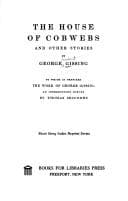
The House of Cobwebs and Other StoriesGissing, George
General
The House of Cobwebs and Other Stories
Gissing, George
Great Britain -- Social life and customs -- 19th century -- Fiction; Short stories
And spluttering and growling, he made known what he had just learnt at his
aunt's home. On the previous afternoon the Christophersons had been
surprised by a visit from their relatives and would-be benefactress, Mrs.
Keeting. Never before had that lady called upon them; she came, no doubt
(this could only be conjectured), to speak with them of their approaching
removal. The close of the conversation (a very brief one) was overheard by
the landlady, for Mrs. Keeting spoke loudly as she descended the stairs.
'Impossible! Quite impossible! I couldn't think of it! How could you dream
for a moment that I would let you fill my house with musty old books? Most
unhealthy! I never knew anything so extraordinary in my life, never!' And
so she went out to her carriage, and was driven away. And the landlady,
presently having occasion to go upstairs, was aware of a dead silence in
the room where the Christophersons were sitting. She knocked--prepared with
some excuse--and found the couple side by side, smiling sadly. At once they
told her the truth. Mrs. Keeting had come because of a letter in which Mrs.
Christopherson had mentioned the fact that her husband had a good many
books, and hoped he might be permitted to remove them to the house in
Norfolk. She came to see the library--with the result already heard. They
had the choice between sacrificing the books and losing what their relative
offered.
'Christopherson refused?' I let fall.
'I suppose his wife saw that it was too much for him. At all events, they'd
agreed to keep the books and lose the house. And there's an end of it. I
haven't been so riled about anything for a long time!'
Meantime I had been reflecting. It was easy for me to understand
Christopherson's state of mind, and without knowing Mrs. Keeting, I saw
that she must be a person whose benefactions would be a good deal of a
burden. After all, was Mrs. Christopherson so very unhappy? Was she not the
kind of woman who lived by sacrifice--one who had far rather lead a life
disagreeable to herself than change it at the cost of discomfort to her
husband? This view of the matter irritated Pomfret, and he broke into
objurgations, directed partly against Mrs. Keeting, partly against
Christopherson. It was an 'infernal shame,' that was all he could say. And
after all, I rather inclined to his opinion.
When two or three days had passed, curiosity drew me towards the
Christophersons' dwelling. Walking along the opposite side of the street, I
looked up at their window, and there was the face of the old bibliophile.
Evidently he was standing at the window in idleness, perhaps in trouble. At
once he beckoned to me; but before I could knock at the house-door he had
descended, and came out.
'May I walk a little way with you?' he asked.
There was worry on his features. For some moments we went on in silence.
'So you have changed your mind about leaving London?' I said, as if
carelessly.
Public-domain text, read in full here on John Shaqi.
Reviews
Reviews
No reviews yet
Be the first to share your thoughts on this work.
Elsewhere in the archive
Join the Discussion
Join the discussion
Sign in to leave a comment or review.
Sign InorCreate an account