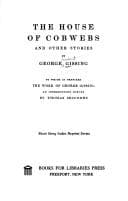
The House of Cobwebs and Other StoriesGissing, George
General
The House of Cobwebs and Other Stories
Gissing, George
Great Britain -- Social life and customs -- 19th century -- Fiction; Short stories
'You have heard from Mr. Pomfret? Well--yes, yes--I think we shall stay
where we are--for the present.'
Never have I seen a man more painfully embarrassed. He walked with head
bent, shoulders stooping; and shuffled, indeed, rather than walked. Even so
might a man bear himself who felt guilty of some peculiar meanness.
Presently words broke from him.
'To tell you the truth, there's a difficulty about the books.' He glanced
furtively at me, and I saw he was trembling in all his nerves. 'As you see,
my circumstances are not brilliant.' He half-choked himself with a crow.
'The fact is we were offered a house in the country, on certain conditions,
by a relative of Mrs. Christopherson; and, unfortunately, it turned out
that my library is regarded as an objection--a fatal objection. We have
quite reconciled ourselves to staying where we are.'
I could not help asking, without emphasis, whether Mrs. Christopherson
would have cared for life in the country. But no sooner were the words out
of my mouth than I regretted them, so evidently did they hit my companion
in a tender place.
'I think she would have liked it,' he answered, with a strangely pathetic
look at me, as if he entreated my forbearance.
'But,' I suggested, 'couldn't you make some arrangements about the books?
Couldn't you take a room for them in another house, for instance?'
Christopherson's face was sufficient answer; it reminded me of his
pennilessness. 'We think no more about it,' he said. 'The matter is
settled--quite settled.'
There was no pursuing the subject. At the next parting of the ways we took
leave of each other.
I think it was not more than a week later when I received a postcard from
Pomfret. He wrote: 'Just as I expected. Mrs. C. seriously ill.' That was
all.
Mrs. C. could, of course, only mean Mrs. Christopherson. I mused over the
message--it took hold of my imagination, wrought upon my feelings; and that
afternoon I again walked along the interesting street.
There was no face at the window. After a little hesitation I decided to
call at the house and speak with Pomfret's aunt. It was she who opened the
door to me.
We had never seen each other, but when I mentioned my name and said I was
anxious to have news of Mrs. Christopherson, she led me into a
sitting-room, and began to talk confidentially.
She was a good-natured Yorkshirewoman, very unlike the common London
landlady. 'Yes, Mrs. Christopherson had been taken ill two days ago. It
began with a long fainting fit. She had a feverish, sleepless night; the
doctor was sent for; and he had her removed out of the stuffy,
book-cumbered bedroom into another chamber, which luckily happened to be
vacant. There she lay utterly weak and worn, all but voiceless, able only
to smile at her husband, who never moved from the bedside day or night. He,
too,' said the landlady, 'would soon break down: he looked like a ghost,
and seemed "half-crazed."'
'What,' I asked, 'could be the cause of this illness?'
Public-domain text, read in full here on John Shaqi.
Reviews
Reviews
No reviews yet
Be the first to share your thoughts on this work.
Elsewhere in the archive
Join the Discussion
Join the discussion
Sign in to leave a comment or review.
Sign InorCreate an account