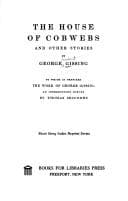
The House of Cobwebs and Other StoriesGissing, George
General
The House of Cobwebs and Other Stories
Gissing, George
Great Britain -- Social life and customs -- 19th century -- Fiction; Short stories
The good woman gave me an odd look, shook her head, and murmured that the
reason was not far to seek.
'Did she think,' I asked, 'that disappointment might have something to do
with it?'
Why, of course she did. For a long time the poor lady had been all but at
the end of her strength, and _this_ came as a blow beneath which she sank.
'Your nephew and I have talked about it,' I said. 'He thinks that Mr.
Christopherson didn't understand what a sacrifice he asked his wife to
make.'
'I think so too,' was the reply. 'But he begins to see it now, I can tell
you. He says nothing but.'
There was a tap at the door, and a hurried tremulous voice begged the
landlady to go upstairs.
'What is it, sir?' she asked.
'I'm afraid she's worse,' said Christopherson, turning his haggard face to
me with startled recognition. 'Do come up at once, please.'
Without a word to me he disappeared with the landlady. I could not go away;
for some ten minutes I fidgeted about the little room, listening to every
sound in the house. Then came a footfall on the stairs, and the landlady
rejoined me.
'It's nothing,' she said. 'I almost think she might drop off to sleep, if
she's left quiet. He worries her, poor man, sitting there and asking her
every two minutes how she feels. I've persuaded him to go to his room, and
I think it might do him good if you went and had a bit o' talk with him.'
I mounted at once to the second-floor sitting-room, and found
Christopherson sunk upon a chair, his head falling forwards, the image of
despairing misery. As I approached he staggered to his feet. He took my
hand in a shrinking, shamefaced way, and could not raise his eyes. I
uttered a few words of encouragement, but they had the opposite effect to
that designed.
'Don't tell me that,' he moaned, half resentfully. 'She's dying--she's
dying--say what they will, I know it.'
'Have you a good doctor?'
'I think so--but it's too late--it's too late.'
As he dropped to his chair again I sat down by him. The silence of a minute
or two was broken by a thunderous rat-tat at the house-door. Christopherson
leapt to his feet, rushed from the room; I, half fearing that he had gone
mad, followed to the head of the stairs.
In a moment he came up again, limp and wretched as before.
'It was the postman,' he muttered. 'I am expecting a letter.'
Conversation seeming impossible, I shaped a phrase preliminary to
withdrawal; but Christopherson would not let me go.
'I should like to tell you,' he began, looking at me like a dog under
punishment, 'that I have done all I could. As soon as my wife fell ill, and
when I saw--I had only begun to think of it in that way--how she felt the
disappointment, I went at once to Mrs. Keeting's house to tell her that I
would sell the books. But she was out of town. I wrote to her--I said I
regretted my folly--I entreated her to forgive me and to renew her kind
offer. There has been plenty of time for a reply, but she doesn't answer.'
Public-domain text, read in full here on John Shaqi.
Reviews
Reviews
No reviews yet
Be the first to share your thoughts on this work.
Elsewhere in the archive
Join the Discussion
Join the discussion
Sign in to leave a comment or review.
Sign InorCreate an account