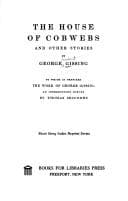
The House of Cobwebs and Other StoriesGissing, George
General
The House of Cobwebs and Other Stories
Gissing, George
Great Britain -- Social life and customs -- 19th century -- Fiction; Short stories
days, he discussed champagne vintages with his publisher, or was consulted
as to the management of butlers by the wife of a popular prelate. With what
a sincere recollection of this time he enjoins his readers (after Dr.
Johnson) to abstain from Poverty. 'Poverty is the great secluder.' 'London
is a wilderness abounding in anchorites.' Gissing was sustained amid all
these miseries by two passionate idealisms, one of the intellect, the other
of the emotions. The first was ancient Greece and Rome--and he incarnated
this passion in the picturesque figure of Julian Casti (in _The
Unclassed_), toiling hard to purchase a Gibbon, savouring its grand epic
roll, converting its driest detail into poetry by means of his enthusiasm,
and selecting Stilicho as a hero of drama or romance (a premonition here of
_Veranilda_). The second or heart's idol was Charles Dickens--Dickens as
writer, Dickens as the hero of a past England, Dickens as humorist, Dickens
as leader of men, above all, Dickens as friend of the poor, the outcast,
the pale little sempstress and the downtrodden Smike.
[Footnote 5: _Isabel Clarendon_. By George Gissing. In two volumes, 1886
(Chapman and Hall). In reviewing this work the _Academy_ expressed
astonishment at the mature style of the writer--of whom it admitted it had
not yet come across the name.]
In the summer of 1870, Gissing remembered with a pious fidelity of detail
the famous drawing of the 'Empty Chair' being framed and hung up 'in the
school-room, at home'[6] (Wakefield).
[Footnote 6: Of Gissing's early impressions, the best connected account, I
think, is to be gleaned from the concluding chapters of _The Whirlpool_;
but this may be reinforced (and to some extent corrected, or, here and
there cancelled) by passages in _Burn in Exile_ (vol. i.) and in
_Ryecroft_. The material there supplied is confirmatory in the best sense
of the detail contributed by Mr. Wells to the cancelled preface of
_Veranilda_, touching the 'schoolboy, obsessed by a consuming passion for
learning, at the Quaker's boarding-school at Alderley. He had come thither
from Wakefield at the age of thirteen--after the death of his father, who
was, in a double sense, the cardinal formative influence in his life. The
tones of his father's voice, his father's gestures, never departed from
him; when he read aloud, particularly if it was poetry he read, his father
returned in him. He could draw in those days with great skill and
vigour--it will seem significant to many that he was particularly
fascinated by Hogarth's work, and that he copied and imitated it; and his
father's well-stocked library, and his father's encouragement, had
quickened his imagination and given it its enduring bias for literary
activity.' Like Defoe, Smollett, Sterne, Borrow, Dickens, Eliot, 'G.C.' is,
half involuntarily, almost unconsciously autobiographic.]
Public-domain text, read in full here on John Shaqi.
Reviews
Reviews
No reviews yet
Be the first to share your thoughts on this work.
Join the Discussion
Join the discussion
Sign in to leave a comment or review.
Sign InorCreate an account