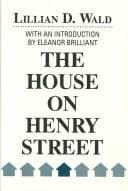
Henry Street Settlement (New York, N.Y.); Poor -- New York (State) -- New York
The woeful lack of imagination displayed in building a city without
recognizing the need of its citizens for recreation through play, music,
and art, has been borne in upon us many times. New Yorkers need to be
reminded that the Metropolitan Museum of Art was effectually closed to
a large proportion of the citizens until, on May 31, 1891, it opened
its doors on Sundays. It is interesting to recall that of the 80,000
signatures to the petition for this privilege, 50,000 were of residents
of the lower East Side and were presented by the “Working People’s
Petition Committee.” The report of the Museum trustees following the
Sunday opening notes that after a little disorder and confusion at
the start the experiment proved a success; that the attendance was
“respectable, law-abiding, and intelligent,” and that “the laboring
classes were well represented.” They were also obliged to report,
however, that the Sunday opening had “offended some of the Museum’s best
friends and supporters,” and that it had “resulted in the loss of a
bequest of $50,000.”
* * * * *
When we left the tenement house we were fortunate to find for sale, on
a street that still bore evidences of its bygone social glory, a house
which readily lent itself to the restorer’s touch. Tradition says that
many of these fine old East Side houses were built by cabinetmakers
who came over from England during the War of 1812 and remained here as
citizens. The generous purchaser allowed us freedom to repair, restore,
and alter, as our taste directed. Attractive as we found the house, we
were even more excited over the possibilities of the little back yard.
Our first organized effort for the neighborhood was to convert this
yard and one belonging to an adjacent school, with, later, the yard of
a third house rented by one of our residents, into a miniature but very
complete playground. There was so little precedent to guide us that our
resourcefulness was stimulated, and we succeeded in achieving what the
President of the National Playground Association has called the “Bunker
Hill” of playgrounds.
Along the borders we planted bright-colored flowers—which were not
disturbed by the children. An old wistaria vine on a trellis covered
nearly a third of the playground, and two ailanthus trees, usually
regarded with contempt by tree lovers, were highly cherished by those who
otherwise would have lived a treeless life. Window-boxes jutted from the
rear windows of the two houses controlled by the settlement, and in one
corner, shaded by a striped awning, we put the big sand-pile. Joy-giving
“scups” (the local name for swings) were erected, and some suitable
gymnastic apparatus, parallel bars and overhead ladder placed. Baby
hammocks were swung, their occupants tenderly cared for by little mothers
and little fathers. Manual training was provided by a picturesque sailor
from Sailors’ Snug Harbor, who, at a stretching frame, taught the making
of hammocks.
Public-domain text, read in full here on John Shaqi.
Reviews
Reviews
No reviews yet
Be the first to share your thoughts on this work.
Join the Discussion
Join the discussion
Sign in to leave a comment or review.
Sign InorCreate an account