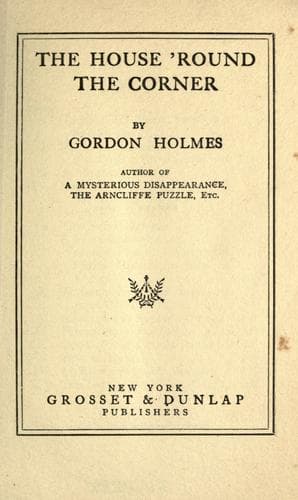
Mystery fiction; Yorkshire (England) -- Social life and customs -- Fiction
While Walker was fiddling with the lock, not being quite sure as to the
right key, Armathwaite had eyed the southern landscape. Elmdale was six
hundred feet above sea level, and the Grange stood fully a hundred feet
higher than the village, so a far-flung panorama of tillage, pasture,
and woodland provided a delightful picture on that glorious June day. To
the north, he knew, stretched miles of wild moor, and the heather began
where the spacious garden ended. A glance at the map in the Walkers'
office had shown that this bleak waste was crossed by mere tracks,
marked in the dotted lines which motorists abhor. Indeed, the very road
leading to the house was not macadamized beyond the gate; two years of
disuse had converted even the stone-covered portion into a sort of
meadow, because grass, the sulkiest of vegetables in a well-tended lawn,
will grow luxuriantly on a granite wall if left alone.
Truly, Elmdale seemed to be at the end of the world--the world of
Yorkshire, at any rate--and Robert Armathwaite found its aspect
pleasing. A lock clicked; he turned, and entered a domain he was now
fully resolved to make his own.
"Well, I'm blest!" said Walker, speaking in a surprised way; "anyone 'ud
think the place hadn't been empty an hour, let alone two years, not
countin' Mrs. Wilkins's couple of nights. I wonder who left these
clothes, and hats, and things!"
He had good reason for a certain stare of bewilderment.
The door, which was stoutly built, with a pane of sheet glass in the
upper half, opened straight into a spacious, oak-paneled hall. Left and
right were a dining-room and a drawing-room, each containing two
windows. Behind the dining-room a wide staircase gave access to the
upper floors, and a flood of rich and variously-tinted light from a long
arched window glowed on the dark panels below, and glistened on the
polished mahogany case of a grandfather's clock which faced the foot of
the stairs. The wall opposite the entrance was pierced by a half-open
door, through which could be seen laden bookshelves reaching up eight
feet or more. Another door, beyond the stairway, showed the only
possible means of approach to the kitchen and domestic offices.
There were no pictures in the hall, but some antique plates and dishes
of blue china were ranged on a shelf above the wainscot, and a narrow
table and four straight-backed chairs, all of oak, were in tasteful
keeping with the surroundings. On each side of the dining-room door were
double rows of hooks, and on these hung the garments which had caught
the agent's eye.
A bowler hat, a frayed panama, a cap, a couple of overcoats, even a
lady's hat and mackintosh, lent an air of occupancy to the house, which
was not diminished by the presence of several sticks and umbrellas in a
couple of Chinese porcelain stands. Walker took down the panama. It was
dust-laden, and the inner band of leather had a clammy feeling. He
replaced it hastily.
Public-domain text, read in full here on John Shaqi.
Reviews
Reviews
No reviews yet
Be the first to share your thoughts on this work.
Join the Discussion
Join the discussion
Sign in to leave a comment or review.
Sign InorCreate an account