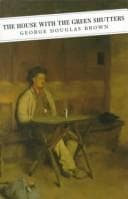
The House with the Green ShuttersBrown, George Douglas
General
The House with the Green Shutters
Brown, George Douglas
Scotland -- Social life and customs -- 19th century -- Fiction
And so, gradually, his dwelling had come to be a passion of Gourlay's
life. It was a by-word in the place that if ever his ghost was seen, it
would be haunting the House with the Green Shutters. Deacon Allardyce,
trying to make a phrase with him, once quoted the saying in his
presence. "Likely enough!" said Gourlay. "It's only reasonable I should
prefer my own house to you rabble in the graveyard!"
Both in appearance and position the house was a worthy counterpart of
its owner. It was a substantial two-story dwelling, planted firm and
gawcey on a little natural terrace that projected a considerable
distance into the Square. At the foot of the steep little bank shelving
to the terrace ran a stone wall, of no great height, and the iron
railings it uplifted were no higher than the sward within. Thus the
whole house was bare to the view from the ground up, nothing in front to
screen its admirable qualities. From each corner, behind, flanking walls
went out to the right and left, and hid the yard and the granaries. In
front of these walls the dwelling seemed to thrust itself out for
notice. It took the eye of a stranger the moment he entered the Square.
"Whose place is that?" was his natural question. A house that challenges
regard in that way should have a gallant bravery in its look; if its
aspect be mean, its assertive position but directs the eye to its
infirmities. There is something pathetic about a tall, cold, barn-like
house set high upon a brae; it cannot hide its naked shame; it thrusts
its ugliness dumbly on your notice, a manifest blotch upon the world, a
place for the winds to whistle round. But Gourlay's house was worthy its
commanding station. A little dour and blunt in the outlines like Gourlay
himself, it drew and satisfied your eye as he did.
And its position, "cockit up there on the brae," made it the theme of
constant remark--to men because of the tyrant who owned it, and to women
because of the poor woman who mismanaged its affairs. "'Deed, I don't
wonder that gurly Gourlay, as they ca' him, has an ill temper," said the
gossips gathered at the pump, with their big, bare arms akimbo;
"whatever led him to marry that dishclout of a woman clean beats _me_! I
never could make head nor tail o't!" As for the men, they twisted every
item about Gourlay and his domicile into fresh matter of assailment.
"What's the news?" asked one, returning from a long absence; to whom
the smith, after smoking in silence for five minutes, said, "Gourlay has
got new rones!" "Ha--ay, man, Gourlay has got new rones!" buzzed the
visitor; and then their eyes, diminished in mirth, twinkled at each
other from out their ruddy wrinkles, as if wit had volleyed between
them. In short, the House with the Green Shutters was on every
tongue--and with a scoff in the voice, if possible.
CHAPTER IV.
Public-domain text, read in full here on John Shaqi.
Reviews
Reviews
No reviews yet
Be the first to share your thoughts on this work.
Join the Discussion
Join the discussion
Sign in to leave a comment or review.
Sign InorCreate an account