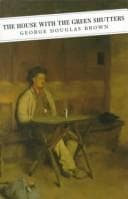
The House with the Green ShuttersBrown, George Douglas
General
The House with the Green Shutters
Brown, George Douglas
Scotland -- Social life and customs -- 19th century -- Fiction
He had come back after an absence of fifteen years, with a good deal of
money in his pocket, and he had a fond desire that he, the son of the
mole-catcher, should get some recognition of his prosperity from the
most important man in the locality. If Gourlay had said, with solemn and
fat-lipped approval, "Man, I'm glad to see that you have done so well,"
he would have swelled with gratified pride. For it is often the
favourable estimate of their own little village--"What they'll think of
me at home"--that matters most to Scotsmen who go out to make their way
in the world. No doubt that is why so many of them go home and cut a
dash when they have made their fortunes; they want the cronies of their
youth to see the big men they have become. Wilson was not exempt from
that weakness. As far back as he remembered Gourlay had been the big man
of Barbie; as a boy he had viewed him with admiring awe; to be received
by him now, as one of the well-to-do, were a sweet recognition of his
greatness. It was a fawning desire for that recognition that caused his
smirking approach to the grain merchant. So strong was the desire that,
though he coloured and felt awkward at the contemptuous reference to his
father, he sniggered and went on talking, as if nothing untoward had
been said. He was one of the band impossible to snub, not because they
are endowed with superior moral courage, but because their easy
self-importance is so great that an insult rarely pierces it enough to
divert them from their purpose. They walk through life wrapped
comfortably round in the wool of their own conceit. Gourlay, though a
dull man--perhaps because he was a dull man--suspected insult in a
moment. But it rarely entered Wilson's brain (though he was cleverer
than most) that the world could find anything to scoff at in such a fine
fellow as James Wilson. A less ironic brute than Gourlay would never
have pierced the thickness of his hide. It was because Gourlay succeeded
in piercing it that morning that Wilson hated him for ever--with a hate
the more bitter because he was rebuffed so seldom.
"Is business brisk?" he asked, irrepressible.
Business! Heavens, did ye hear him talking? What did Toddling Johnny's
son know about business? What was the world coming to? To hear him
setting up his face there, and asking the best merchant in the town
whether business was brisk! It was high time to put him in his place,
the conceited upstart, shoving himself forward like an equal!
For it was the assumption of equality implied by Wilson's manner that
offended Gourlay--as if mole-catcher's son and monopolist were
discussing, on equal terms, matters of interest to them both.
"Business!" he said gravely. "Well, I'm not well acquainted with your
line, but I believe mole traps are cheap--if ye have any idea of taking
up the oald trade."
Public-domain text, read in full here on John Shaqi.
Reviews
Reviews
No reviews yet
Be the first to share your thoughts on this work.
Join the Discussion
Join the discussion
Sign in to leave a comment or review.
Sign InorCreate an account