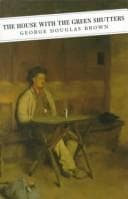
The House with the Green ShuttersBrown, George Douglas
General
The House with the Green Shutters
Brown, George Douglas
Scotland -- Social life and customs -- 19th century -- Fiction
Teutonic Brown, had a Celtic contempt for brute facts that cripple the
imperial mind. So well did he expatiate that young Gourlay would slink
home to his mother and say, "Yah, even Swipey Broon has been to Fechars,
though my faither 'ull no allow _me_!" "Never mind, dear," she would
soothe him; "when once you're in the business, you'll gang a'where. And
nut wan o' them has sic a business to gang intill!"
But though he longed to go here and there for a day, that he might be
able to boast of it at home, young Gourlay felt that leaving Barbie for
good would be a cutting of his heart-strings. Each feature of it, town
and landward, was a crony of old years. In a land like Barbie, of quick
hill and dale, of tumbled wood and fell, each facet of nature has an
individuality so separate and so strong that if you live with it a
little it becomes your friend, and a memory so dear that you kiss the
thought of it in absence. The fields are not similar as pancakes; they
have their difference; each leaps to the eye with a remembered and
peculiar charm. That is why the heart of the Scot dies in flat southern
lands; he lives in a vacancy; at dawn there is no Ben Agray to nod
recognition through the mists. And that is why, when he gets north of
Carlisle, he shouts with glee as each remembered object sweeps on the
sight: yonder's the Nith with a fisherman hip-deep jigging at his rod,
and yonder's Corsoncon with the mist on his brow. It is less the
totality of the place than the individual feature that pulls at the
heart, and it was the individual feature that pulled at young Gourlay.
With intellect little or none, he had a vast, sensational experience,
and each aspect of Barbie was working in his blood and brain. Was there
ever a Cross like Barbie Cross? Was there ever a burn like the Lintie?
It was blithe and heartsome to go birling to Skeighan in the train; it
was grand to jouk round Barbie on the nichts at e'en! Even people whom
he did not know he could locate with warm sure feelings of superiority.
If a poor workman slouched past him on the road, he set him down in his
heart as one of that rotten crowd from the Weaver's Vennel or the
Tinker's Wynd. Barbie was in subjection to the mind of the son of the
important man. To dash about Barbie in a gig, with a big dog walloping
behind, his coat-collar high about his ears, and the reek of a
meerschaum pipe floating white and blue many yards behind him, jovial
and sordid nonsense about home--that had been his ideal. His father, he
thought angrily, had encouraged the ideal, and now he forbade it, like
the brute he was. From the earth in which he was rooted so deeply his
father tore him, to fling him on a world he had forbidden him to know.
His heart presaged disaster.
Public-domain text, read in full here on John Shaqi.
Reviews
Reviews
No reviews yet
Be the first to share your thoughts on this work.
Elsewhere in the archive
Join the Discussion
Join the discussion
Sign in to leave a comment or review.
Sign InorCreate an account