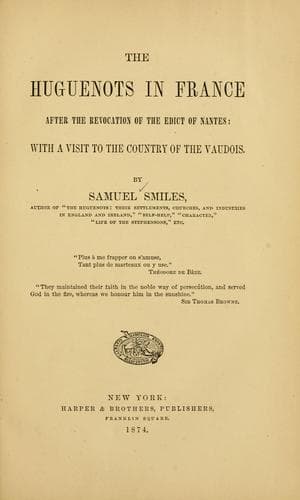
Dauphiné (France) -- Description and travel; Huguenots; Waldenses
Again Montrevel thought he had succeeded in crushing the insurrection,
and that he had cut off its head with that of the Camisard chief. But
his supposed discovery of the dead body proved an entire mistake; and
not many days elapsed before Cavalier made his appearance before the
gates of Alais, and sent in a challenge to the governor to come out
and fight him. And it is to be observed that by this time a fiercely
combative spirit, of fighting for fighting's sake, began to show
itself among the Camisards. Thus, Castanet appeared one day before the
gates of Meyreuis, where the regiment of Cordes was stationed, and
challenged the colonel to come out and fight him in the open; but the
challenge was declined. On another occasion, Cavalier in like manner
challenged the commander of Vic to bring out thirty of his soldiers
and fight thirty Camisards. The challenge was accepted, and the battle
took place; they fought until ten men only remained alive on either
side, but the Camisards were masters of the field.
Montrevel only redoubled his efforts to exterminate the Camisards. He
had no other policy. In the summer of 1703 the Pope (Clement XI.) came
to his assistance, issuing a bull against the rebels as being of "the
execrable race of the ancient Albigenses," and promising "absolute and
general remission of sins" to all such as should join the holy militia
of Louis XIV. in "exterminating the cursed heretics and miscreants,
enemies alike of God and of Cæsar."
A special force was embodied with this object--the Florentines, or
"White Camisards"--distinguished by the white cross which they wore in
front of their hats. They were for the most part composed of
desperadoes and miscreants, and went about pillaging and burning, with
so little discrimination between friend and foe, that the Catholics
themselves implored the marshal to suppress them. These Florentines
were the perpetrators of such barbarities that Roland determined to
raise a body of cavalry to hunt them down; and with that object,
Catinat, the old dragoon, went down to the Camargues--a sort of
island-prairies lying between the mouths of the Rhône--where the Arabs
had left a hardy breed of horses; and there he purchased some two
hundred steeds wherewith to mount the Camisard horse, to the command
of which Catinat was himself appointed.
It is unnecessary to particularise the variety of combats, of
marchings and countermarchings, which occurred during the progress of
the insurrection. Between the contending parties, the country was
reduced to a desert. Tillage ceased, for there was no certainty of the
cultivator reaping the crop; more likely it would be carried off or
burnt by the conflicting armies. Beggars and vagabonds wandered about
robbing and plundering without regard to party or religion; and social
security was entirely at an end.
Public-domain text, read in full here on John Shaqi.
Reviews
Reviews
No reviews yet
Be the first to share your thoughts on this work.
Elsewhere in the archive
Join the Discussion
Join the discussion
Sign in to leave a comment or review.
Sign InorCreate an account