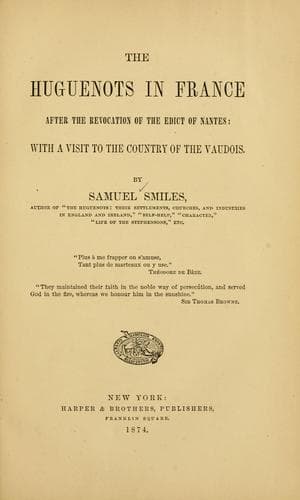
Dauphiné (France) -- Description and travel; Huguenots; Waldenses
Meanwhile, Montrevel still called for more troops. Of the twenty
battalions already entrusted to him, more than one-third had perished;
and still the insurrection was not suppressed. He hoped, however, that
the work was now accomplished; and, looking to the wasted condition of
the country, that the famine and cold of the winter of 1703-4 would
complete the destruction of such of the rebels as still survived.
During the winter, however, the Camisard chiefs had not only been able
to keep their forces together, but to lay up a considerable store of
provisions and ammunition, principally by captures from the enemy; and
in the following spring they were in a position to take the field in
even greater force than ever. They, indeed, opened the campaign by
gaining two important victories over the Royalists; but though they
were their greatest, they were also nearly their last.
The battle of Martinargues was the Cannæ of the Camisards. It was
fought near the village of that name, not far from Ners, early in the
spring of 1704. The campaign had been opened by the Florentines, who,
now that they had made a desert of the Upper Cevennes, were burning
and ravaging the Protestant villages of the plain. Cavalier had put
himself on their track, and pursued and punished them so severely,
that in their distress they called upon Montrevel to help them,
informing him of the whereabouts of the Camisards.
A strong royalist force of horse and foot was immediately sent in
pursuit, under the command of Brigadier Lajonquière. He first marched
upon the Protestant village of Lascours, where Cavalier had passed the
previous night. The brigadier severely punished the inhabitants for
sheltering the Camisards, putting to death four persons, two of them
girls, whom he suspected to be Cavalier's prophetesses. On the people
refusing to indicate the direction in which the Camisards had gone, he
gave the village up to plunder, and the soldiers passed several hours
ransacking the place, in the course of which they broke open and
pillaged the wine-cellars.
Meanwhile, Cavalier and his men had proceeded in a northerly
direction, along the right bank of the little river Droude, one of the
affluents of the Gardon. A messenger from Lascours overtook him,
telling him of the outrages committed on the inhabitants of the
village; and shortly after, the inhabitants of Lascours themselves
came up--men, women, and children, who had been driven from their
pillaged homes by the royalist soldiery. Cavalier was enraged at the
recital of their woes; and though his force was not one-sixth the
strength of the enemy, he determined to meet their advance and give
them battle.
Public-domain text, read in full here on John Shaqi.
Reviews
Reviews
No reviews yet
Be the first to share your thoughts on this work.
Elsewhere in the archive
Join the Discussion
Join the discussion
Sign in to leave a comment or review.
Sign InorCreate an account