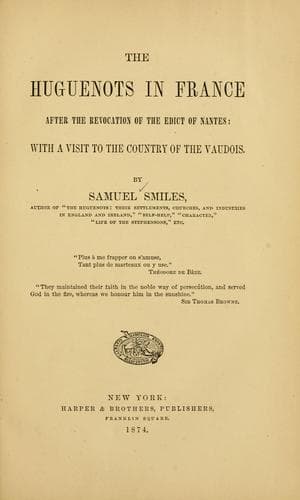
Dauphiné (France) -- Description and travel; Huguenots; Waldenses
After the Camisard war, and before the appearance of Court, these
meetings rarely numbered more than a hundred persons. But Court and
his fellow-pastors often held meetings at which more than two thousand
people were present. On one occasion, not less than four thousand
persons attended an assembly in Lower Languedoc.
When the meetings were held by day, they were carefully guarded and
watched by sentinels on the look-out, especially in those places near
which garrisons were stationed. The fleetest of the young men were
chosen for this purpose. They watched the garrison exits, and when the
soldiers made a sortie, the sentinels communicated by signal from hill
to hill, thus giving warning to the meeting to disperse. But the
assemblies were mostly held at night; and even then the sentinels were
carefully posted about, but not at so great a distance.
The chief of the whole organization was the pastor. First, there were
the members entitled to church, privileges; next the _anciens_; and
lastly the pastors. As in Presbyterianism, so in Huguenot Calvinism,
its form of government was republican. The organization was based upon
the people who elected their elders; then upon the elders who selected
and recommended the pastors; and lastly upon the whole congregation of
members, elders, and pastors (represented in synods), who maintained
the entire organization of the Church.
There were three grades of service in the rank of pastor--first
students, next preachers, and lastly pastors. Wonderful that there
should have been students of a profession, to follow which was almost
equal to a sentence of death! But there were plenty of young
enthusiasts ready to brave martyrdom in the service of the proscribed
Church. Sometimes it was even necessary to restrain them in their
applications.
Court once wrote to Pierre Durand, at a time when the latter was
restoring order and organization in Viverais: "Sound and examine well
the persons offering themselves for your approval, before permitting
them to enter on this glorious employment. Secure good, virtuous men,
full of zeal for the cause of truth. It is piety only that inspires
nobility and greatness of soul. Piety sustains us under the most
extreme dangers, and triumphs over the severest obstacles. The good
conscience always marches forward with its head erect."
When the character of the young applicants was approved, their studies
then proceeded, like everything else connected with the proscribed
religion, in secret. The students followed the professor and pastor in
his wanderings over the country, passing long nights in marching,
sometimes hiding in caves by day, or sleeping under the stars by
night, passing from meeting to meeting, always with death looming
before them.
Public-domain text, read in full here on John Shaqi.
Reviews
Reviews
No reviews yet
Be the first to share your thoughts on this work.
Elsewhere in the archive
Join the Discussion
Join the discussion
Sign in to leave a comment or review.
Sign InorCreate an account