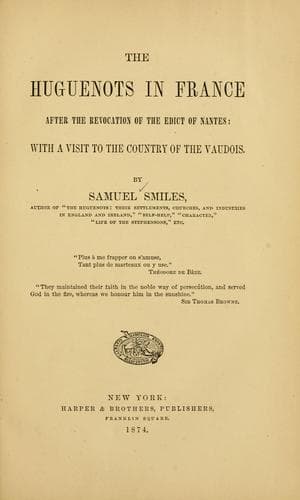
Dauphiné (France) -- Description and travel; Huguenots; Waldenses
[Footnote 10: Such was, in fact, the end of a man so
distinguished as M. Paul Chenevix, Councillor of the Court of
Metz, who died in 1686, the year after the Revocation.
Although of the age of eighty, and so illustrious for his
learning, his dead body was dragged along the streets on a
hurdle and thrown upon a dunghill. See "Huguenot Refugees and
their Descendants," under the name _Chenevix_. The present
Archbishop of Dublin is descended from his brother Philip
Chenevix, who settled in England shortly after the
Revocation.]
For several years before the Revocation, while the persecutions of the
Huguenots had been increasing, many had realised their means, and fled
abroad into Switzerland, Germany, Holland, and England. But after the
Revocation, emigration from France was strictly forbidden, under
penalty of confiscation of the whole goods and property of the
emigrant. Any person found attempting to leave the country, was liable
to the seizure of all that belonged to him, and to perpetual
imprisonment at the galleys; one half the amount realised by the sale
of the property being paid to the informers, who thus became the most
active agents of the Government. The Act also ordered that all landed
proprietors who had left France before the Revocation, should return
within four months, under penalty of confiscation of all their
property.
Amongst those of the King's subjects who were the most ready to obey
his orders were some of the old Huguenot noble families, such as the
members of the houses of Bouillon, Coligny, Rohan, Tremouille, Sully,
and La Force. These great vassals, whom a turbulent feudalism had
probably in the first instance induced to embrace Protestantism, were
now found ready to change their profession of religion in servile
obedience to the monarch.
The lesser nobility were more faithful and consistent. Many of them
abandoned their estates and fled across the frontier, rather than live
a daily lie to God by forswearing the religion of their conscience.
Others of this class, on whom religion sat more lightly, as the only
means of saving their property from confiscation, pretended to be
converted to Roman Catholicism; though, we shall find, that these "new
converts," as they were called, were treated with as much suspicion on
the one side as they were regarded with contempt on the other.
There were also the Huguenot manufacturers, merchants, and employers of
labour, of whom a large number closed their workshops and factories,
sold off their goods, converted everything into cash, at whatever
sacrifice, and fled across the frontier into Switzerland--either
settling there, or passing through it on their way to Germany, Holland,
or England.
Public-domain text, read in full here on John Shaqi.
Reviews
Reviews
No reviews yet
Be the first to share your thoughts on this work.
Join the Discussion
Join the discussion
Sign in to leave a comment or review.
Sign InorCreate an account