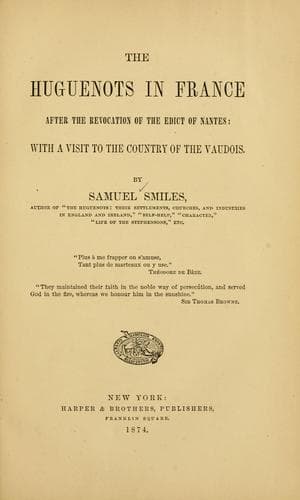
Dauphiné (France) -- Description and travel; Huguenots; Waldenses
And yet it was at this time that the Bishop of Alais made an appeal to
the government against the toleration shown to the Huguenots! In 1723,
he sent a long memorial to Paris, alleging that Catholicism was
suffering a serious injury; that not only had the "new converts"
withdrawn themselves from the Catholic Church, but that the old
Catholics themselves were resorting to the Huguenot assemblies; that
sometimes their meetings numbered from three to four thousand persons;
that their psalms were sometimes overheard in the surrounding
villages; that the churches were becoming deserted, the curés in some
parishes not being able to find a single Catholic to serve at Mass;
that the Protestants had ceased to send their children to school, and
were baptized and married without the intervention of the Church.
In consequence of these representations, the then Regent, the Duke of
Bourbon, sent down an urgent order to the authorities to carry out the
law--to prevent meetings, under penalty of death to preachers, and
imprisonment at the galleys to all who attended them, ordering that
the people should be _forced_ to go to church and the children to
school, and reviving generally the severe laws against Protestantism
issued by Louis XIV. The result was that many of the assemblies were
shortly after attacked and dispersed, many persons were made prisoners
and sent to the galleys, and many more preachers were apprehended,
racked, and hanged.
Repeated attempts were made to apprehend Antoine Court, as being the
soul of the renewed Protestant organization. A heavy reward was
offered for his head. The spies and police hunted after him in all
directions. Houses where he was supposed to be concealed were
surrounded by soldiers at night, and every hole and corner in them
ransacked. Three houses were searched in one night. Court sometimes
escaped with great difficulty. On one occasion he remained concealed
for more than twenty hours under a heap of manure. His friends
endeavoured to persuade him to leave the country until the activity of
the search for him had passed.
Since the year 1722, Court had undertaken new responsibilities. He had
become married, and was now the father of three children. He had
married a young Huguenot woman of Uzes. He first met her in her
father's house, while he was in hiding from the spies. While he was
engaged in his pastoral work his wife and family continued to live at
Uzes. Court was never seen in her company, but could only visit his
family secretly. The woman was known to be of estimable character, but
it gave rise to suspicions that she had three children without a known
father. The spies were endeavouring to unravel the secret, tempted by
the heavy reward offered for Court's head.
Public-domain text, read in full here on John Shaqi.
Reviews
Reviews
No reviews yet
Be the first to share your thoughts on this work.
Elsewhere in the archive
Join the Discussion
Join the discussion
Sign in to leave a comment or review.
Sign InorCreate an account