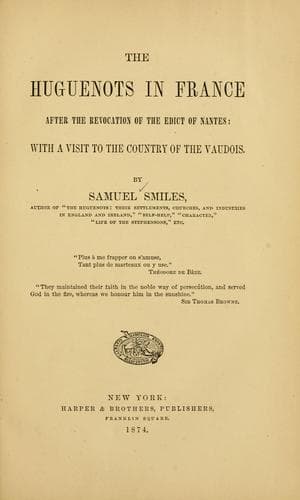
Dauphiné (France) -- Description and travel; Huguenots; Waldenses
One day the new commandant of the town, passing before the door of the
house where Court's wife lived, stopped, and, pointing to the house,
put some questions to the neighbours. Court was informed of this, and
immediately supposed that his house had become known, that his wife
and family had been discovered and would be apprehended. He at once
made arrangements for having them removed to Geneva. They reached that
city in safety, in the month of April, 1729.
Shortly after, Court, still wandering and preaching about Languedoc,
became seriously ill. He feared for his wife, he feared for his
family, and conceived the design of joining them in Switzerland. A few
months later, exhausted by his labours and continued illness, he left
Languedoc and journeyed by slow stages to Geneva. He was still a young
man, only thirty-three; but he had worked excessively hard during the
last dozen years. Since the age of fourteen, in fact, he had
evangelized Languedoc.
Shortly before Court left France for Switzerland, the preacher,
Alexandre Roussel, was, in the year 1728, added to the number of
martyrs. He was only twenty-six years of age. The occasion on which he
was made prisoner was while attending an assembly near Vigan. The
whole of the people had departed, and Roussel was the last to leave
the meeting. He was taken to Montpellier, and imprisoned in the
citadel, which had before held so many Huguenot pastors. He was asked
to abjure, and offered a handsome bribe if he would become a Catholic.
He refused to deny his faith, and was sentenced to die. When Antoine
Court went to offer consolation to his mother, she replied, "If my son
had given way I should have been greatly distressed; but as he died
with constancy, I thank God for strengthening him to perform this last
work in his service."
Court did not leave his brethren in France without the expostulations
of his friends. They alleged that his affection for his wife and
family had cooled his zeal for God's service. Duplan and Cortez
expostulated with him; and the churches of Languedoc, which he himself
had established, called upon him to return to his duties amongst them.
But Court did not attend to their request. His determination was for
the present unshaken. He had a long arrears of work to do in quiet. He
had money to raise for the support of the suffering Church of France,
and for the proper maintenance of the college for students, preachers,
and pastors. He had to help the refugees, who still continued to leave
France for Switzerland, and to write letters and rouse the Protestant
kingdoms of the north, as Brousson had done before him some thirty
years ago.
Public-domain text, read in full here on John Shaqi.
Reviews
Reviews
No reviews yet
Be the first to share your thoughts on this work.
Elsewhere in the archive
Join the Discussion
Join the discussion
Sign in to leave a comment or review.
Sign InorCreate an account