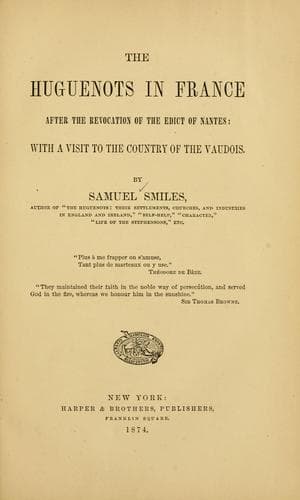
Dauphiné (France) -- Description and travel; Huguenots; Waldenses
Their "loyalty" proved of no use. The towns of Languedoc were as
heavily fined as before, for attending meetings in the Desert.[65]
Children were, as usual, taken away from their parents and placed in
Jesuit convents. Le Nain apprehended Jean Desjours, and had him hanged
at Montpellier, on the ground that he had accompanied the peasants
who, as above recited, went into Vernoux after the martyr Désubas.
[Footnote 65: Près de Saint-Ambroix (Cevennes) se tint un
jour une assemblée. Survint un détachement. Les femmes et les
filles furent dépouillées, violées, et quelques hommes furent
blessés.--E. HUGHES, _Histoire de la Restauration, &c._, ii.
212.]
The Catholics would not even allow Protestant corpses to be buried in
peace. At Levaur a well-known Huguenot died. Two of his friends went
to dig a grave for him by night; they were observed by spies and
informed against. By dint of money and entreaties, however, the
friends succeeded in getting the dead man buried. The populace,
stirred up by the White Penitents (monks), opened the grave, took out
the corpse, sawed the head from the body, and prepared to commit
further outrages, when the police interfered, and buried the body
again, in consideration of the large sum that had been paid to the
authorities for its interment.
The populace were always wild for an exhibition of cruelty. In
Provence, a Protestant named Montague died, and was secretly interred.
The Catholics having discovered the place where he was buried
determined to disinter him. The grave was opened, and the corpse taken
out. A cord was attached to the neck, and the body was hauled through
the village to the music of a tambourine and flageolet. At every step
it was kicked or mauled by the crowd who accompanied it. Under the
kicks the corpse burst. The furious brutes then took out the entrails
and attached them to poles, going through the village crying, "Who
wants preachings? Who wants preachings?"[66]
[Footnote 66: Antoine Court, "Mémoire Historique," 140.]
To such a pitch of brutality had the kings of France and their
instigators, the Jesuits--who, since the Revocation of the Edict, had
nearly the whole education of the country in their hands--reduced the
people; from whom they were themselves, however, to suffer almost an
equal amount of indignity.
In the midst of these hangings and cruelties, the bishops again
complained bitterly of the tolerance granted to the Huguenots. M. de
Montclus, Bishop of Alais, urged "that the true cause of all the evils
that afflict the country was the relaxation of the laws against heresy
by the magistrates, that they gave themselves no trouble to persecute
the Protestants, and that their further emigration from the kingdom
was no more to be feared than formerly." It was, they alleged, a great
danger to the country that there should be in it two millions of men
allowed to live without church and outside the law.[67]
Public-domain text, read in full here on John Shaqi.
Reviews
Reviews
No reviews yet
Be the first to share your thoughts on this work.
Elsewhere in the archive
Join the Discussion
Join the discussion
Sign in to leave a comment or review.
Sign InorCreate an account