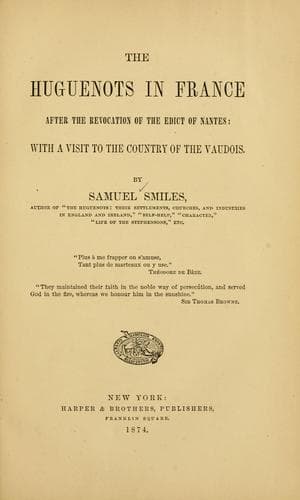
Dauphiné (France) -- Description and travel; Huguenots; Waldenses
Then followed the death of Antoine Court himself in Switzerland--after
watching over the education and training of preachers at the Lausanne
Seminary. Feeling his powers beginning to fail, he had left Lausanne,
and resided at Timonex. There, assisted by his son Court de Gébelin,
Professor of Logic at the College, he conducted an immense
correspondence with French Protestants at home and abroad.
Court's wife died in 1755, to his irreparable loss. His "Rachel,"
during his many years of peril, had been his constant friend and
consoler. Unable, after her death, to live at Timonex, so full of
cruel recollections, Court returned to Lausanne. He did not long
survive his wife's death. While engaged in writing the history of the
Reformed Church of France, he was taken ill. His history of the
Camisards was sent to press, and he lived to revise the first
proof-sheets. But he did not survive to see the book published. He
died on the 15th June, 1760, in the sixty-fourth year of his age.
From the time of Court's death--indeed from the time that Court left
France to settle at Lausanne--Paul Rabaut continued to be looked upon
as the leader and director of the proscribed Huguenot Church. Rabaut
originally belonged to Bedarieux in Languedoc. He was a great friend
of Pradel's. Rabaut served the Church at Nismes, and Pradel at Uzes.
Both spent two years at Lausanne in 1744-5. Court entertained the
highest affection for Rabaut, and regarded him as his successor. And
indeed he nobly continued the work which Court had begun.
Besides being zealous, studious, and pious, Rabaut was firm, active,
shrewd, and gentle. He stood strongly upon moral force. Once, when the
Huguenots had become more than usually provoked by the persecutions
practised on them, they determined to appear armed at the assemblies.
Rabaut peremptorily forbade it. If they persevered, he would forsake
their meetings. He prevailed, and they came armed only with their
Bibles.
The directness of Rabaut's character, the nobility of his sentiments,
the austerity of his life, and his heroic courage, evidently destined
him as the head of the work which Court had begun. Antoine Court! Paul
Rabaut! The one restored Protestantism in France, the other rooted and
established it.
Rabaut's enthusiasm may be gathered from the following extract of a
letter which he wrote to a friend at Geneva: "When I fix my attention
upon the divine fire with which, I will not say Jesus Christ and the
Apostles, but the Reformed and their immediate successors, burned for
the salvation of souls, it seems to me that, in comparison with them,
we are ice. Their immense works astound me, and at the same time cover
me with confusion. What would I not give to resemble them in
everything laudable!"
Public-domain text, read in full here on John Shaqi.
Reviews
Reviews
No reviews yet
Be the first to share your thoughts on this work.
Elsewhere in the archive
Join the Discussion
Join the discussion
Sign in to leave a comment or review.
Sign InorCreate an account