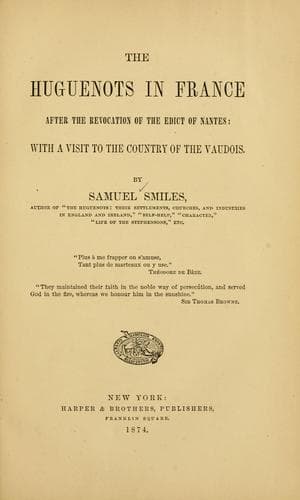
Dauphiné (France) -- Description and travel; Huguenots; Waldenses
Rabaut had the same privations, perils, and difficulties to undergo as
the rest of the pastors in the Desert. He had to assume all sorts of
names and disguises while he travelled through the country, in order
to preach at the appointed places. He went by the names of M. Paul, M.
Denis, M. Pastourel, and M. Theophile; and he travelled under the
disguises of a common labourer, a trader, a journeyman, and a baker.
He was condemned to death, as a pastor who preached in defiance of the
law; but his disguises were so well prepared, and the people for whom
he ministered were so faithful to him, that the priests and other
spies never succeeded in apprehending him. Singularly enough, he was
in all other respects in favour of the recognition of legal authority,
and strongly urged his brethren never to adopt any means whatever of
forcibly resisting the King's orders.
Many of the military commanders were becoming disgusted with the
despicable and cowardly business which the priests called upon them to
do. Thus, on one occasion, a number of Protestants had assembled at
the house of Paul Rabaut at Nismes, and, while they were on their
knees, the door was suddenly burst open, when a man, muffled up,
presented himself, and throwing open his cloak, discovered the
military commandant of the town. "My friends," he said, "you have Paul
Rabaut with you; in a quarter of an hour I shall be here with my
soldiers, accompanied by Father ----, who has just laid the
information against you." When the soldiers arrived, headed by the
commandant and the father, of course no Paul Rabaut was to be found.
"For more than thirty years," says one of Paul Rabaut's biographers,
"caverns and huts, whence he was unearthed like a wild animal, were
his only habitation. For a long time he dwelt in a safe hiding-place
that one of his faithful guides had provided for him, under a pile of
stones and thorn-bushes. It was discovered at length by a shepherd,
and such was the wretchedness of his condition, that, when he was
forced to abandon the place, he still regretted this retreat, which
was more fit for savage beasts than men."
Yet this hut of piled stones was for some time the centre of
Protestant affairs in France. All the faithful instinctively turned to
Rabaut when assailed by fresh difficulties and persecutions, and acted
on his advice. He obtained the respect even of the Catholics
themselves, because it was known that he was a friend of peace, and
opposed to all risings and rebellions amongst his people.
Once he had the courage to present a petition to the Marquis de
Paulmy, Minister of War, when changing horses at a post-house between
Nismes and Montpellier. Rabaut introduced himself by name, and the
Marquis knew that it was the proscribed pastor who stood before him.
He might have arrested and hanged Rabaut on the spot; but, impressed
by the noble bearing of the pastor, he accepted the petition, and
promised to lay it before the king.
CHAPTER XIII
Public-domain text, read in full here on John Shaqi.
Reviews
Reviews
No reviews yet
Be the first to share your thoughts on this work.
Elsewhere in the archive
Join the Discussion
Join the discussion
Sign in to leave a comment or review.
Sign InorCreate an account