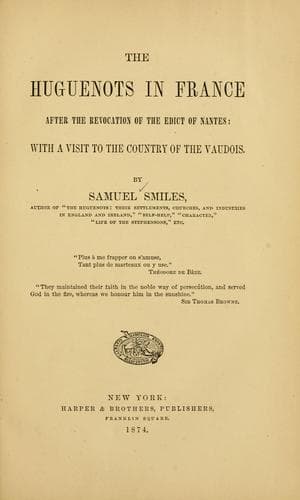
Dauphiné (France) -- Description and travel; Huguenots; Waldenses
END OF THE PERSECUTIONS--THE FRENCH REVOLUTION.
In the year 1762, the execution of an unknown Protestant at Toulouse
made an extraordinary noise in Europe. Protestant pastors had so often
been executed, that the punishment had ceased to be a novelty.
Sometimes they were simply hanged; at other times they were racked,
and then hanged; and lastly, they were racked, had their larger bones
broken, and were then hanged. Yet none of the various tortures
practised on the Protestant pastors had up to that time excited any
particular sensation in France itself, and still less in Europe.
Cruelty against French Huguenots was so common a thing in those days,
that few persons who were of any other religion, or of no religion at
all, cured anything about it. The Protestants were altogether outside
the law. When a Protestant meeting was discovered and surrounded, and
men, women, and children were at once shot down, no one could call the
murderers in question, because the meetings were illegal. The persons
taken prisoners at the meetings were brought before the magistrates
and sentenced to punishments even worse than death. They might be sent
to the galleys, to spend the remainder of their lives amongst
thieves, murderers, and assassins. Women and children found at such
meetings might also be sentenced to be imprisoned in the Tour de
Constance. There were even cases of boys of twelve years old having
been sent to the galleys for life, because of having accompanied their
parents to "the Preaching."[70]
[Footnote 70: Athanase Coquerel, "Les Forçats pour la Foi,"
91.]
The same cruelties were at that time practised upon the common people
generally, whether they were Huguenots or not. The poor creatures,
whose only pleasure consisted in sometimes hunting a Protestant, were
so badly off in some districts of France that they even fed upon
grass. The most distressed districts in France were those in which the
bishops and clergy were the principal owners of land. They were the
last to abandon slavery, which continued upon their estates until
after the Revolution.
All these abominations had grown up in France, because the people had
begun to lose the sense of individual liberty. Louis XIV. had in his
time prohibited the people from being of any religion different from
his own. "His Majesty," said his Prime Minister Louvois, "will not
suffer any person to remain in his kingdom who shall not be of his
religion." And Louis XV. continued the delusion. The whole of the
tyrannical edicts and ordinances of Louis XIV. continued to be
maintained.
Public-domain text, read in full here on John Shaqi.
Reviews
Reviews
No reviews yet
Be the first to share your thoughts on this work.
Elsewhere in the archive
Join the Discussion
Join the discussion
Sign in to leave a comment or review.
Sign InorCreate an account