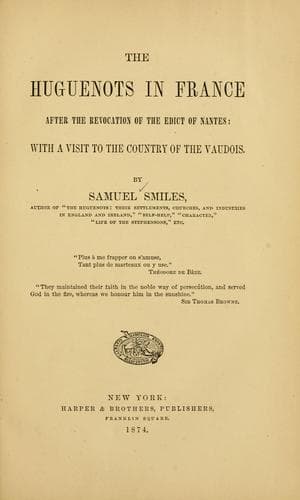
Dauphiné (France) -- Description and travel; Huguenots; Waldenses
It is not known when the last Huguenot women were liberated from the
Tour de Constance, at Aiguesmortes. It would probably be about the
time when the last Huguenots were liberated from the galleys. An
affecting picture has been left by an officer who visited the prison
at the release of the last prisoners. "I accompanied," he says, "the
Prince de Beauvau (the intendant of Languedoc under Louis XVI.) in a
survey which he made of the coast. Arriving at Aiguesmortes, at the
gate of the Tour de Constance, we found at the entrance the principal
keeper, who conducted us by dark steps through a great gate, which
opened with an ominous noise, and over which was inscribed a motto
from Dante--'Lasciate ogni speranza voi che'ntrate.'
"Words fail me to describe the horror with which we regarded a scene
to which we were so unaccustomed--a frightful and affecting picture,
in which the interest was heightened by disgust. We beheld a large
circular apartment, deprived of air and of light, in which fourteen
females still languished in misery. It was with difficulty that the
Prince smothered his emotion; and doubtless it was the first time that
these unfortunate creatures had there witnessed compassion depicted
upon a human countenance; I still seem to behold the affecting
apparition. They fell at our feet, bathed in tears, and speechless,
until, emboldened by our expressions of sympathy, they recounted to us
their sufferings. Alas! all their crime consisted in having been
attached to the same religion as Henry IV. The youngest of these
martyrs was more than fifty years old. She was but _eight_ when first
imprisoned for having accompanied her mother to hear a religious
service, and her punishment had continued until now!"[82]
[Footnote 82: Froissard, "Nismes et ses Environs," ii. 217.]
After the liberation of the last of the galley-slaves there were no
further apprehensions nor punishments of Protestants. The priests had
lost their power; and the secular authority no longer obeyed their
behests. The nation had ceased to believe in them; in some places they
were laughed at; in others they were detested. They owed this partly
to their cruelty and intolerance, partly to their luxury and
self-indulgence amidst the poverty of the people, and partly to the
sarcasms of the philosophers, who had become more powerful in France
than themselves. "It is not enough," said Voltaire, "that we prove
intolerance to be horrible; we must also prove to the French that it
is ridiculous."
Public-domain text, read in full here on John Shaqi.
Reviews
Reviews
No reviews yet
Be the first to share your thoughts on this work.
Elsewhere in the archive
Join the Discussion
Join the discussion
Sign in to leave a comment or review.
Sign InorCreate an account