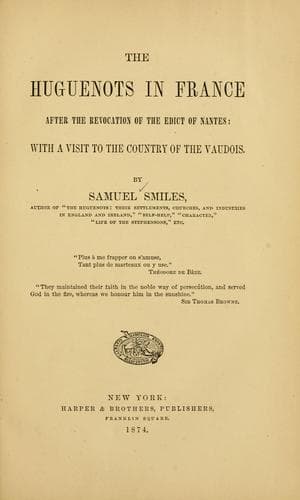
Dauphiné (France) -- Description and travel; Huguenots; Waldenses
In looking back at the sufferings of the Huguenots remaining in France
since the Revocation of the Edict of Nantes; at the purity,
self-denial, honesty, and industry of their lives; at the devotion
with which they adhered to religious duty and the worship of God; we
cannot fail to regard them--labourers and peasants though they
were--as amongst the truest, greatest, and worthiest heroes of their
age. When society in France was falling to pieces; when its men and
women were ceasing to believe in themselves and in each other; when
the religion of the State had become a mass of abuse, consistent only
in its cruelty; when the debauchery of its kings[83] had descended
through the aristocracy to the people, until the whole mass was
becoming thoroughly corrupt; these poor Huguenots seem to have been
the only constant and true men, the only men holding to a great idea,
for which they were willing to die--for they were always ready for
martyrdom by the rack, the gibbet, or the galleys, rather than forsake
the worship of God freely and according to conscience.
[Footnote 83: Such was the dissoluteness of the manners of
the court, that no less than 500,000,000 francs of the public
debt, or £20,000,000 sterling, had been incurred for expenses
too ignominious to bear the light, or even to be named in the
public accounts. It appears from an authentic document,
quoted in Soulavie's history, that in the sixteen months
immediately preceding the death of Louis XV., Madame du Barry
(originally a courtesan,) had drawn from the royal treasury
no less than 2,450,000 francs, or equal to about £200,000 of
our present money. ["Histoire de la Décadence de la Monarchie
Française," par Soulavie l'Aîné, iii. 330.] "La corruption,"
says Lacretelle, "entrait dans les plus paisibles ménages,
dans les familles les plus obscures. Elle [Madame du Barri]
était savamment et longtemps combinée par ceux qui servaient
les débauches de Louis. Des émissaires étaient employées à
séduire des filles qui n'étaient point encore nubiles, à
combattre dans de jeunes femmes des principes de pudeur et de
fidélité. Amant de grade, il livrait à la prostitution
publique celles de ses sujettes qu'il avait prématurement
corrompues. Il souffrait que les enfans de ses infâmes
plaisirs partageassent la destinée obscure et dangereuse de
ceux qu'un père n'avoue point." LACRETELLE, _Histoire de
France pendant le xviii Siècle_, iii. 171-173.]
Public-domain text, read in full here on John Shaqi.
Reviews
Reviews
No reviews yet
Be the first to share your thoughts on this work.
Elsewhere in the archive
Join the Discussion
Join the discussion
Sign in to leave a comment or review.
Sign InorCreate an account