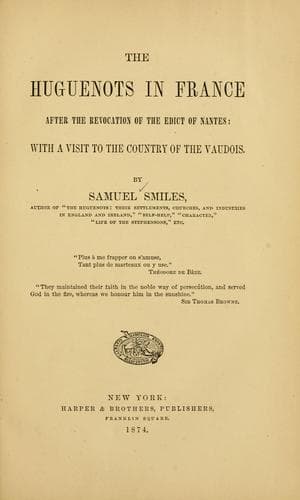
Dauphiné (France) -- Description and travel; Huguenots; Waldenses
He did not, however, occupy the position long. In the struggles of the
Convention he took part with the Girondists, and refused to vote for
the death of Louis XVI. He maintained an obstinate struggle against
the violence of the Mountain. His arrest was decreed; he was dragged
before the revolutionary tribunal, and condemned to be executed within
twenty-four hours.
The horrors of the French Revolution hide the doings of Protestantism
and Catholicism alike for several years, until Buonaparte came into
power. He recognised Catholicism as the established religion, and paid
for the maintenance of the bishops and priests. He also protected
Protestantism, the members of which were entitled to all the benefits
secured to the other Christian communions, "with the exception of
pecuniary subvention."
The comparative liberty which the Protestants of France had enjoyed
under the Republic and the Empire seemed to be in some peril at the
restoration of the Bourbons. The more bigoted Roman Catholics of the
South hailed their return as the precursors of renewed persecution:
and they raised the cry of "Un Dieu, un Roi, une Foi."
The Protestant mayor of Nismes was publicly insulted, and compelled to
resign his office. The mob assembled in the streets and sang ferocious
songs, threatening to "make black puddings of the blood of the
Calvinists' children."[85] Another St. Bartholomew was even
threatened; the Protestants began to conceal themselves, and many fled
for refuge to the Upper Cevennes. Houses were sacked, their inmates
outraged, and in many cases murdered.
[Footnote 85: See the Rev. Mark Wilks's "History of the
Persecutions endured by the Protestants of the South of
France, 1814, 1815, 1816." Longmans, 1821.]
The same scenes occurred in most of the towns and villages of the
department of Gard; and the authorities seemed to be powerless to
prevent them. The Protestants at length began to take up arms for
their defence; the peasantry of the Cevennes brought from their secret
places the rusty arms which their fathers had wielded more than a
century before; and another Camisard war seemed imminent.
In the meantime, the subject of the renewed Protestant persecutions in
the South of France was, in May, 1816, brought under the notice of the
British House of Commons by Sir Samuel Romilly--himself the descendant
of a Languedoc Huguenot--in a powerful speech; and although the
motion was opposed by the Government, there can be little doubt that
the discussion produced its due effect; for the Bourbon Government,
itself becoming alarmed, shortly after adopted vigorous measures, and
the persecution was brought to an end.
Public-domain text, read in full here on John Shaqi.
Reviews
Reviews
No reviews yet
Be the first to share your thoughts on this work.
Elsewhere in the archive
Join the Discussion
Join the discussion
Sign in to leave a comment or review.
Sign InorCreate an account