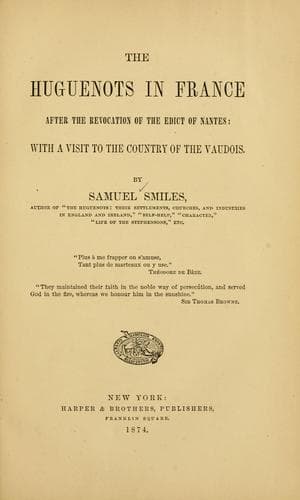
Dauphiné (France) -- Description and travel; Huguenots; Waldenses
But their persecution was now in a great measure at an end. It is
true the Protestants were not recognised, but they nevertheless held
their worship openly, and were not interfered with. When Louis XVI.
succeeded to the throne in 1774, on the administration of the oath for
the extermination of heretics denounced by the Church, the Archbishop
of Toulouse said to him: "It is reserved for you to strike the final
blow against Calvinism in your dominions. Command the dispersion of
the schismatic assemblies of the Protestants, exclude the sectarians,
without distinction, from all offices of the public administration,
and you will insure among your subjects the unity of the true
Christian religion."
No attention was paid to this and similar appeals for the restoration
of intolerance. On the contrary, an Edict of Toleration was issued by
Louis XVI. in 1787, which, though granting a legal existence to the
Protestants, nevertheless set forth that "The Catholic, Apostolic, and
Roman religion alone shall continue to enjoy the right of public
worship in our realm."
Opinion, however, moved very fast in those days. The Declaration of
Rights of 1789 overthrew the barriers which debarred the admission of
Protestants to public offices. On the question of tolerance, Rabaut
Saint-Etienne, son of Paul Rabaut, who sat in the National Assembly
for Nismes, insisted on the freedom of the Protestants to worship God
after their accustomed forms. He said he represented a constituency of
360,000, of whom 120,000 were Protestants. The penal laws against the
worship of the Reformed, he said, had never been formally abolished.
He claimed the rights of Frenchmen for two millions of useful
citizens. It was not toleration he asked for, _it was liberty_.
"Toleration!" he exclaimed; "sufferance! pardon! clemency! ideas
supremely unjust towards the Protestants, so long as it is true that
difference of religion, that difference of opinion, is not a crime!
Toleration! I demand that toleration should be proscribed in its turn,
and deemed an iniquitous word, dealing with us as citizens worthy of
pity, as criminals to whom pardon is to be granted!"[84]
[Footnote 84: "History of the Protestants of France," by G.
de Félice, book v. sect. i.]
The motion before the House was adopted with a modification, and all
Frenchmen, without distinction of religious opinions, were declared
admissible to all offices and employments. Four months later, on the
15th March, 1790, Rabaut Saint-Etienne himself, son of the long
proscribed pastor of the Desert, was nominated President of the
Constituent Assembly, succeeding to the chair of the Abbé Montesquieu.
Public-domain text, read in full here on John Shaqi.
Reviews
Reviews
No reviews yet
Be the first to share your thoughts on this work.
Elsewhere in the archive
Join the Discussion
Join the discussion
Sign in to leave a comment or review.
Sign InorCreate an account