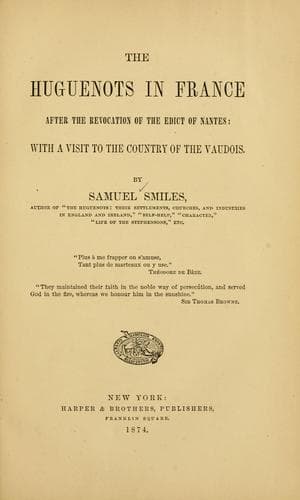
Dauphiné (France) -- Description and travel; Huguenots; Waldenses
To this day the Protestants of Languedoc cherish the memory of their
wanderings and worshippings in the Desert; and they still occasionally
hold their meetings in the old frequented places. Not far from Nismes
are several of these ancient meeting-places of the persecuted, to
which we have above referred. One of them is about two miles from the
city, in the bed of a mountain torrent. The worshippers arranged
themselves along the slopes of the narrow valley, the pastor preaching
to them from the grassy level in the hollow, while sentinels posted
on the adjoining heights gave warning of the approach of the enemy.
Another favourite place of meeting was the hollow of an ancient quarry
called the Echo, from which the Romans had excavated much of the stone
used in the building of the city. The congregation seated themselves
around the craggy sides, the preacher's pulpit being placed in the
narrow pass leading into the quarry. Notwithstanding all the
vigilance of the sentinels, many persons of both sexes and various
ages were often dragged from the Echo to imprisonment or death. Even
after the persecutions had ceased, these meeting-places continued to
be frequented by the Protestants of Nismes, and they were sometimes
attended by five or six thousand persons, and on sacrament days by
even double that number.
Although the Protestants of Languedoc for the most part belong to the
National Reformed Church, the independent character of the people has
led them to embrace Protestantism in other forms. Thus, the
Evangelical Church is especially strong in the South, whilst the
Evangelical Methodists number more congregations and worshippers in
Languedoc than in all the rest of France. There are also in the
Cevennes several congregations of Moravian Brethren. But perhaps one
of the most curious and interesting issues of the Camisard war is the
branch of the Society of Friends still existing in Languedoc--the only
representatives of that body in France, or indeed on the European
continent.
When the Protestant peasants of the Cevennes took up arms and
determined to resist force by force, there were several influential
men amongst them who kept back and refused to join them. They held
that the Gospel they professed did not warrant them in taking up arms
and fighting, even against the enemies who plundered and persecuted
them. And when they saw the excesses into which the Camisards were led
by the war of retaliation on which they had entered, they were the
more confirmed in their view that the attitude which the rebels had
assumed, was inconsistent with the Christian religion.
Public-domain text, read in full here on John Shaqi.
Reviews
Reviews
No reviews yet
Be the first to share your thoughts on this work.
Elsewhere in the archive
Join the Discussion
Join the discussion
Sign in to leave a comment or review.
Sign InorCreate an account