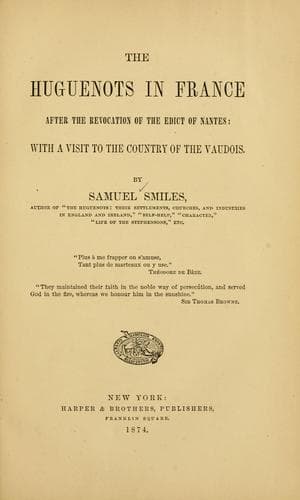
Dauphiné (France) -- Description and travel; Huguenots; Waldenses
After the war had ceased, these people continued to associate
together, maintaining a faithful testimony against war, refusing to
take oaths, and recognising silent worship, without dependence on
human acquirements. They were not aware of the existence of a similar
body in England and America until the period of the French Revolution,
when some intercourse began to take place between them.
In 1807, Stephen Grellet, an American Friend, of French origin,
visited Languedoc, and held many religious meetings in the towns and
villages of the Lower Cevennes, which were not only attended by the
Friends of Congenies, St. Hypolite, Granges, St. Grilles, Fontane's,
Vauvert, Quissac, and other places in the neighbourhood of Nismes, but
by the inhabitants at large, Roman Catholics as well as Protestants.
At that time, as now, Congenies was regarded as the centre of the
district principally inhabited by the Friends, and there they possess
a large and commodious meeting-house, built for the purpose of
worship.
At the time of Stephen Grellet's visit, he especially mentioned Louis
Majolier as "a father and a pillar" amongst the little flock.[86] And
it may not be unworthy to note that the daughter of the same Louis
Majolier is at the present time one of the most acceptable female
preachers of the Society of Friends in England.
[Footnote 86: "Life of Stephen Grellet," third edition.
London, 1870.]
It may also be mentioned, in passing, that there still exist amongst
the Vosges mountains the remnants of an ancient sect--the Anabaptists
of Munster--who hold views in many respects similar to those of the
Friends. Amongst other things, they testify against war as
unchristian, and refuse under any circumstances to carry arms. Rather
than do so, they have at different times suffered imprisonment,
persecution, and even death. The republic of 1793 respected their
scruples, and did not require the Anabaptists to fight in the ranks,
but employed them as pioneers and drivers, while Napoleon made them
look after the wounded on the field of battle, and attend to the
waggon train and ambulances.[87] And we understand that they continue
to be similarly employed down to the present time.
[Footnote 87: Michel, "Les Anabaptistes des Vosges." Paris,
1862.]
* * * * *
Public-domain text, read in full here on John Shaqi.
Reviews
Reviews
No reviews yet
Be the first to share your thoughts on this work.
Elsewhere in the archive
Join the Discussion
Join the discussion
Sign in to leave a comment or review.
Sign InorCreate an account