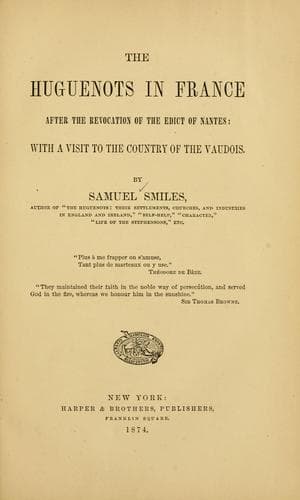
Dauphiné (France) -- Description and travel; Huguenots; Waldenses
Among the distinguished French nobles in London was the Marquis de
Montandre, descended from the De la Rochefoucaulds, one of the
greatest families in France. De Montandre was a field-marshal in the
English army, having rendered important services in the Spanish war.
His wife was daughter of Baron de Spanheim, Ambassador Extraordinary
for the King of Prussia, and descended from another Protestant
refugee. The field-marshal left his fortune to his wife, and when she
died, she left Samuel Pechell, Master in Chancery, her sole executor
and residuary legatee. The sum of money to which he became entitled on
her decease amounted to upwards of £40,000. But Mr. Pechell, from a
highly sensitive conscience--such as is rarely equalled--did not feel
himself perfectly justified in acquiring so large a fortune until he
knew that there were no relations of the testatrix in existence, whose
claim to inherit the property might be greater than his own. He
therefore collected all her effects, and put them into Chancery, in
order that those who could make good their claims by kindred to the
Marchioness might do so before the Chancellor. Accordingly, one family
from Berlin and another from Geneva appeared, and claimed, and
obtained the inheritance. These relations, in acknowledgment of the
kindness and honesty of Mr. Pechell, resolved on presenting him with a
set of Sèvres china, which was at that time beyond all price in value.
It could only be had as a great favour from the manufactory at Sèvres,
and was only purchased by, or presented to, crowned heads.[91]
[Footnote 91: This china is now at Castle Goring, and, with
the whole of the family documents, is in the possession of
the Dowager Lady Burrell.]
Paul Pechell, who had entered the army, became a distinguished
officer, and rose to the rank of general. In 1797 he was created a
baronet, and married Mary, the only daughter and heiress of Thomas
Brooke, Esq., of Pagglesham, Essex. His eldest son, Sir Thomas, was a
major-general in the army, and was for some time M.P. for Downton. The
second son, Augustus, was appointed Receiver-General of the Post
Office in 1785, and of the Customs in 1790. Many of his descendants
still survive, and the baronetcy reverted to his second son. He was
succeeded by his two sons, one of whom became rear-admiral, and the
other vice-admiral. The latter, Sir George Richard Brooke Pechell,
entered the Royal Navy in 1803, and served with distinction in several
engagements. After the peace, he represented the important borough of
Brighton in Parliament for twenty-four years. He married the daughter
and coheir of Cecil, Lord Zouche, and added Castle Goring to part of
the ancient possessions of the Bisshopp family, which she inherited at
her father's death.
Public-domain text, read in full here on John Shaqi.
Reviews
Reviews
No reviews yet
Be the first to share your thoughts on this work.
Elsewhere in the archive
Join the Discussion
Join the discussion
Sign in to leave a comment or review.
Sign InorCreate an account