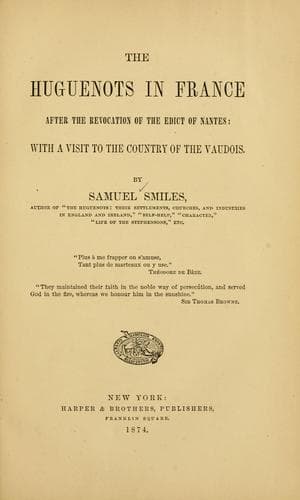
Dauphiné (France) -- Description and travel; Huguenots; Waldenses
William Cecil Pechell, the only son of Sir George, again following the
military instincts of his race, entered the army, and became captain
of the 77th regiment, with which he served during the Crimean war. He
fell leading on his men to repel an attack made by the Russians on the
advanced trenches before Sebastopol, on the 3rd of September, 1855. He
was beloved and deeply lamented by all who knew him; and sorrow at his
loss was expressed by the Queen, by the Commander-in-Chief, by the
whole of the light division, and by the mayor and principal
inhabitants of Brighton. A statue of Captain Pechell, by Noble, was
erected by public subscription, and now stands in the Pavilion at
Brighton.
II.
CAPTAIN RAPIN,
AUTHOR OF THE "HISTORY OF ENGLAND."
When Louis XIV. revoked the Edict of Nantes, he expelled from France
nearly all his subjects who would not conform to the Roman Catholic
religion. He drove out the manufacturers, who were for the most part
Protestants, and thus destroyed the manufacturing supremacy of France.
He expelled Protestants of every class--advocates, judges, doctors,
artists, scientists, teachers, and professors. And, last of all, he
expelled the Protestant soldiers and sailors.
According to Vauban, 12,000 tried soldiers, 9,000 sailors, and 600
officers left France, and entered into foreign service. Some went to
England, some to Holland, and some to Prussia. Those who took refuge
in Holland entered the service of William, Prince of Orange. Most of
them accompanied him to Torbay in 1688. They fought against the armies
of Louis XIV. at the Boyne, at Athlone, and at Aughrim, and finally
drove the French out of Ireland.
The sailors also did good service under the flags of England and
Holland. They distinguished themselves at the sea-fight off La Hogue,
where the English and Dutch fleets annihilated the expedition
prepared by Louis XIV. for a descent upon England.
The expatriated French soldiers occasionally revisited the country of
their birth, not as friends, but as enemies. They encountered the
armies of Louis XIV. in all the battles of the Low Countries. They
fought at Ramilies, Blenheim, and Malplacquet. A Huguenot engineer
directed the operations at the siege of Namur, which ended in the
capture of the fortress. Another Huguenot engineer conducted the
operations at Lisle, which was also taken by the allied forces. While
there, a flying party, consisting chiefly of French Huguenots,
penetrated as far as the neighbourhood of Paris, when they nearly
succeeded in carrying off the Dauphin.
Public-domain text, read in full here on John Shaqi.
Reviews
Reviews
No reviews yet
Be the first to share your thoughts on this work.
Elsewhere in the archive
Join the Discussion
Join the discussion
Sign in to leave a comment or review.
Sign InorCreate an account