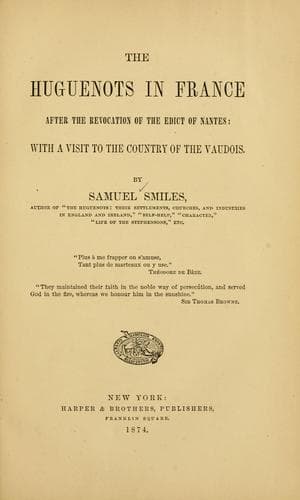
Dauphiné (France) -- Description and travel; Huguenots; Waldenses
Feeling safe under the royal commission, he presented to the
Parliament at Toulouse the edict with which he was intrusted. He then
retired to his country house at Grenade, on the outskirts of Toulouse.
He was there seized like a criminal, brought before the judges, and
sentenced to be beheaded in three days. The treaty was thus annulled.
War went on as before. Two years after, the army of Coligny appeared
before Toulouse. The houses and châteaux of the councillors of
Parliament were burnt, and on their smoking ruins were affixed the
significant words, "_Vengeance de Rapin_."
Philibert de Rapin's son Pierre embraced the career of arms almost
from his boyhood. He served under the Prince of Navarre. He was almost
as poor as the Prince. One day he asked him for some pistoles to
replace a horse which had been killed under him in action. The Prince
replied, "I should like to give you them, but do you see I have only
three shirts!" Pierre at length became Seigneur and Baron of Manvers,
though his château was destroyed and burnt during his absence with the
army. Destructions of the same kind were constantly taking place
throughout the whole of France. But, to the honour of humanity, it
must be told that when his château was last destroyed, the Catholic
gentlemen of the neighbourhood brought their labourers to the place,
and tilled and sowed his abandoned fields. When Rapin arrived eight
months later, he was surprised and gratified to find his estate in
perfect order. This was a touching proof of the esteem with which this
Protestant gentleman was held by his Catholic neighbours.
Pierre de Rapin died in 1647 at the age of eighty-nine. He left
twenty-two children by his second wife. His eldest son Jean succeeded
to the estate of Manvers and to the title of baron. Like his father,
he was a soldier. He first served under the Prince of Orange, who was
then a French prince, head of the principality of Orange. He served
under the King of France in the war with Spain. He was a frank and
loyal soldier, yet firmly attached to the faith of his fathers. He
belonged to the old Huguenot phalanx, who, as the Duke de Mayenne
said, "were always ready for death, from father to son." After the
wars were over, he gave up the sword for the plough. His château was
in ruins, and he had to live in a very humble way until his fortunes
were restored. He used to say that his riches consisted in his four
sons, who were all worthy of the name they bore.
Public-domain text, read in full here on John Shaqi.
Reviews
Reviews
No reviews yet
Be the first to share your thoughts on this work.
Elsewhere in the archive
Join the Discussion
Join the discussion
Sign in to leave a comment or review.
Sign InorCreate an account