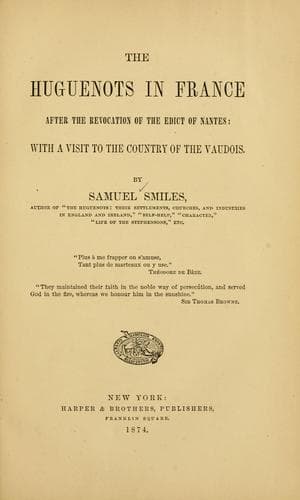
Dauphiné (France) -- Description and travel; Huguenots; Waldenses
Jacques de Rapin, Seigneur de Thoyras, was the second son of Pierre de
Rapin. Thoyras was a little hamlet near Grenade, adjacent to the
baronial estate of Manvers. Jacques studied the law. He became an
advocate, and practised with success, for about fifty years, at
Castres and other cities and towns in the south of France. When the
Edict of Nantes was revoked, the Protestants were no longer permitted
to practise the law, and he was compelled to resign his profession. He
died shortly after, but the authorities would not even allow his
corpse to be buried in the family vault. They demolished his place of
interment, and threw his body into a ditch by the side of the road.
In the meantime Paul de Rapin, son of Jean, Baron de Manvers, had
married the eldest daughter of Jacques, Seigneur de Thoyras. Paul,
like many of his ancestors, entered the army. He served with
distinction under the Duke of Luxembourg in Holland, Flanders, and
Italy, yet he never rose above the rank of captain. On his death in
1685, his widow and two daughters (being Protestants) were apprehended
in their château at Manvers, and incarcerated in convents at
Montpellier and Toulouse. Her sons were also taken away, and placed in
other convents. They were only liberated after five years'
confinement.
Madame de Rapin then resolved to quit France entirely. She contrived
to reach Holland, and established her family at Utrecht. Her
brother-in-law, Daniel de Rapin, had already escaped from France, and
achieved the position of colonel in the Dutch service.
Raoul de Cazenove, the author of "Rapin-Thoyras, sa Famille, sa Vie,
et ses OEuvres," says, "The women of the house of Rapin distinguished
themselves more than once by like courage. Strengthened and fortified
by persecutions, the Reformed were willing to die in exile, far from
their beloved children who had been violently snatched from them, but
leaving with them a holy heritage of example and of firmness in their
faith. The pious lessons of their mothers, profoundly engraved on the
hearts of their daughters, sufficed more than once to save them from
apostasy, which was rendered all the more easy by the feebleness of
their youth and the perfidious suggestions by which they were
surrounded."
We return to Paul de Rapin-Thoyras, second son of Madame de Rapin. He
was born at Castres in 1661. He received his first lessons at home. He
learnt the Latin rudiments, but his progress was not such as to
please his father. He was then sent to the academy at Puylaurens,
where the Protestant noblesse of the south of France were still
permitted to send their sons. The celebrated Bayle was educated there.
But in 1685 the academy of Puylaurens was suppressed, as that of
Montauban had been a few years before; and then young Rapin was sent
to Saumur, one of the few remaining schools in France where
Protestants were allowed to be educated.
Public-domain text, read in full here on John Shaqi.
Reviews
Reviews
No reviews yet
Be the first to share your thoughts on this work.
Elsewhere in the archive
Join the Discussion
Join the discussion
Sign in to leave a comment or review.
Sign InorCreate an account