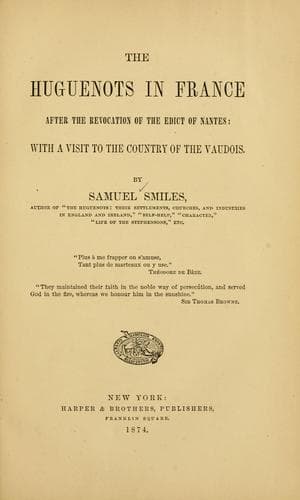
Dauphiné (France) -- Description and travel; Huguenots; Waldenses
At Utrecht he joined his uncle, Daniel de Rapin, who was in command of
a company of cadets wholly composed of Huguenot gentlemen and nobles.
Daniel had left the service of France on the 25th of October, 1685,
three days after the Revocation of the Edict of Nantes. He was then
captain of a French regiment in Picardy, but he could no longer,
without denying his God, serve his country and his King. In fact, he
was compelled, like all other Protestant officers, to leave France
unless he would at once conform to the King's faith.
Rapin was admitted to the company of refugee cadets commanded by his
uncle. He was now twenty-seven years old. His first instincts had been
military, and now he was about to pursue the profession of arms in his
adopted country. His first prospects were not brilliant. He was put
under a course of discipline, his pay amounting to only sixpence a
day. Indeed, the States-General of Holland were at first unwilling to
take so large a number of refugee Frenchmen into their service; but on
the Prince of Orange publicly declaring that he would himself pay the
expenses of maintaining the military refugees, they hesitated no
longer, but voted money enough to enrol them in their service.
The Prince of Orange had now a large body of troops at his command. No
one knew for what purpose they were enrolled. Some thought they were
intended for an attack upon France in revenge for Louis' devastation
of Holland a few years before. James II. never dreamt that they were
intended for a descent upon the coasts of England. Yet he was rapidly
alienating the loyalty of his subjects by hypocrisy, by infidelity to
the laws of England, and by unmitigated persecution of those who
differed from him in religious belief. In this state of affairs
England looked to the Prince of Orange for help.
William III. was doubly related to the royal family of England. He was
nephew of Charles I. and son-in-law of James II. His wife was the
heiress-presumptive to the British throne. Above all, he was a
Protestant, while James II. was a Roman Catholic. "Here," said the
Archbishop of Rheims of the latter, "is a good sort of man who has
lost his three kingdoms for a mass!"
William was at length ready with his troops. Louis XIV. suddenly
withdrew his army from Flanders and poured them into Germany. William
seized the opportunity. A fleet of more than six hundred vessels,
including fifty men-of-war, assembled at Helvoetsluys, near the mouth
of the Maas. The troops were embarked with great celerity. William
hoisted his flag with the words emblazoned on it, "The Protestant
Religion and Liberties of England," and underneath the motto of the
House of Nassau, _Je maintiendra_--"I will maintain."
The fleet set sail on the 19th October, the English Admiral Herbert
leading the van, the Prince of Orange commanding the main body of the
fleet, and the Dutch Vice-Admiral Evertzen bringing up the rear.
Public-domain text, read in full here on John Shaqi.
Reviews
Reviews
No reviews yet
Be the first to share your thoughts on this work.
Elsewhere in the archive
Join the Discussion
Join the discussion
Sign in to leave a comment or review.
Sign InorCreate an account