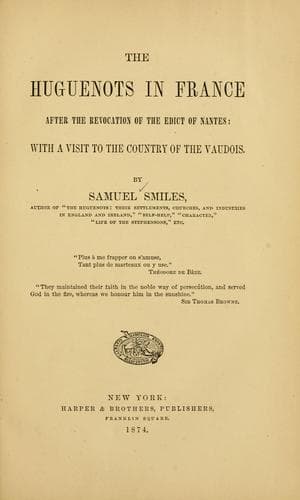
Dauphiné (France) -- Description and travel; Huguenots; Waldenses
The fleet sailed from Brest on the 7th of March, 1689, and reached
Kinsale, in the south of Ireland, four days later. James II. was
received with the greatest rejoicing. Next day he went on to Cork; he
was received by the Earl of Tyrconnel, who caused one of the
magistrates to be executed because he had declared for the Prince of
Orange.
The news went abroad that the King had landed. He entered Dublin on
the 24th of March, and was received in a triumphant manner. All Roman
Catholic Ireland was at his feet. The Protestants in the south were
disarmed. There was some show of resistance in the north; but no doubt
was entertained that Enniskillen and Derry, where the Protestants had
taken refuge, would soon be captured and Protestantism crushed.
The Prince of Orange, who had now been proclaimed King at Westminster,
found that he must fight for his throne, and that Ireland was to be
the battle-field. Londonderry was crowded with Protestants, who held
out for William III. James believed that the place would fall without
a blow. Count Rosen was of the same opinion. The Irish army proceeded
northwards without resistance. The country, as far as the walls of
Derry, was found abandoned by the population. Everything valuable had
been destroyed by bands of Rapparees. There was great want of food for
the army.
Nevertheless, James proceeded as far as Derry. Confident of success,
he approached within a hundred yards of the southern gate, when he was
received with a shout of "No surrender!" The cannon were fired from
the nearest bastion. One of James's officers was killed by his side.
Then he fled. A few days later he was on his way to Dublin,
accompanied by Count Rosen.
Londonderry, after an heroic contest, was at length relieved. A fleet
from England, laden with food, broke the boom which had been thrown by
the Irish army across the entrance to the harbour. The ships reached
the quay at ten o'clock at night. The whole population were there to
receive them. The food was unloaded, and the famished people were at
length fed. Three days after, the Irish army burnt their huts, and
left the long-beleaguered city. They retreated along the left bunk of
the Boyne to Strabane.
While the Irish forces were lying there, the news of another disaster
reached them. The Duke of Berwick lay with a strong detachment of
Irish troops before Enniskillen. He had already gained some advantage
over the Protestant colonists, and the command reached him from Dublin
that he was immediately to attack them. The Irish were five thousand
in number; the Enniskilleners under three thousand.
Public-domain text, read in full here on John Shaqi.
Reviews
Reviews
No reviews yet
Be the first to share your thoughts on this work.
Elsewhere in the archive
Join the Discussion
Join the discussion
Sign in to leave a comment or review.
Sign InorCreate an account